bonus
La Noche Es Femenina
The inevitable loneliness of starting a new life. Also I got strapped into a bungee harness with four women and zero Spanish comprehension, learned that The Simpsons is apparently funnier in Spanish, named my kefir Bicho, and rode through the insane streets of CDMX at night with a friend for the first time. Also I have thoughts about masculine and feminine nouns and they are not entirely diplomatic.
Please show some support for the podcast and get access to some extra content by subscribing to the Patreon page: http://www.patreon.com/onefjef
Instagram: @onefjefpod
Facebook: https://www.facebook.com/onefjefpod
TikTok: @onefjefpodcast
YouTube: https://www.youtube.com/@onefjef
Email: onefjefpod@gmail.com
You can also call the podcast and leave a voicemail at 1-669-241-5882 and I will probably play it on the air.
Thank you for listening, please do it again, pero en la noche.
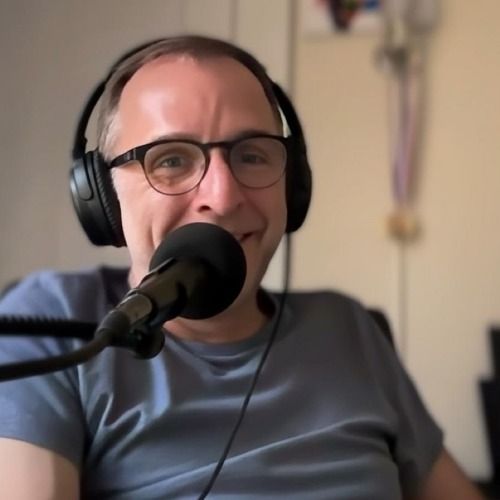
Onefjef is produced, edited & hosted by Jef Taylor.
Transcript
This is CDMX Dispatch number seven, the first one in a while that has not been
Speaker:considered an official episode, and also the first one in a while that will be
Speaker:released to the Patreon subscribers first.
Speaker:So congratulations, you're back.
Speaker:I've been living in Mexico City for a little more than two months now,
Speaker:and in some ways it's getting easier
Speaker:You know, I'm meeting some friends, doing social stuff
Speaker:taking Spanish classes, so forth and so on.
Speaker:But in other ways
Speaker:I wouldn't necessarily say it's getting harder.
Speaker:No, I would.
Speaker:I would say it's getting harder in a way
Speaker:It's the loneliness 'cause when you do a thing like this, like what I'm doing
Speaker:here, there's phases of adapting to your new life, and I think the first
Speaker:phase is just like excitement, bliss, everything's wonderful, this is gonna be
Speaker:great, et cetera, et cetera, et cetera.
Speaker:Honeymoon phase, I believe they call it.
Speaker:It's like you're, you know, still a tourist, but you're actually gonna stay.
Speaker:And the second phase starts when you realize you're not a tourist anymore,
Speaker:and that you have to actually deal with real-life things like groceries, um,
Speaker:bills, getting work, et cetera, et cetera, et cetera, and also that learning Spanish
Speaker:is gonna be harder than you imagined.
Speaker:And then I think the phase I'm in now is the I understand this is my new life, and
Speaker:I understand this is what I chose, and I understand that I knew this was gonna
Speaker:be hard beforehand, and I understand that all of this is a part of it
Speaker:But I'm lonely.
Speaker:I'm lonely.
Speaker:And it's funny, I didn't really think that I would be, or I didn't consider
Speaker:it when I-- before I moved here.
Speaker:Not that I would have changed anything, but I guess I didn't comprehend the
Speaker:loneliness, you know, the level of it.
Speaker:It comes and goes, but Sundays are always hard, I feel like,
Speaker:because... I don't know.
Speaker:Sundays have always been hard.
Speaker:Why should it be any different in Mexico City?
Speaker:And for me, there's also like this, this nagging judgment of myself that I really
Speaker:have to shake, and it's that like, "Oh, okay, you're living in Mexico City now.
Speaker:Are you doing the things that you wanted to do?
Speaker:Like, are you spending time in the wonderful park?" And the truth is, I
Speaker:haven't done a lot of those things.
Speaker:I've done some of the things, for sure.
Speaker:And so when I think about it, I can say, "Okay, no, you have done a lot
Speaker:of stuff." It's just different, right?
Speaker:I think that's the thing is I experienced Mexico City originally
Speaker:as a tourist for an extended period of time, but I was still a tourist.
Speaker:There was nothing real about it.
Speaker:I wasn't really buying groceries, right?
Speaker:And as a result, it was, you know, of course, it's all gonna be magical.
Speaker:You're a tourist, right?
Speaker:You know you're leaving.
Speaker:You know when you're leaving.
Speaker:But there's a moment after you move to a place, for ex-- after you, you
Speaker:know, expatriate or whatever the, or repatriate to a place where you
Speaker:realize, I, I'm, I'm not a tourist.
Speaker:This is my life.
Speaker:This is my real life.
Speaker:And I don't feel like I have roots here yet.
Speaker:I don't know how long that takes.
Speaker:Not like familial roots, just like roots, you know?
Speaker:Roots like I grew in Columbus and I grew in New York.
Speaker:I mean, I guess if I think about it in another way, the positive way,
Speaker:I could say I do have some roots here, but you know what I mean.
Speaker:You know what I mean.
Speaker:And if you don't, um, email me at onefjefpod@gmail.com,
Speaker:I'll explain it to you
Speaker:This morning, Patricia and I went to this, uh, I don't know what it's called,
Speaker:bungee aero fitness or something.
Speaker:I don't know what the name of it is.
Speaker:It's apparently all over the place, um, in the United States and elsewhere.
Speaker:But y- you go to this place.
Speaker:I would never have even occurred to me to, to even do this.
Speaker:I would never have done this by myself because it was entirely in Spanish, and
Speaker:had Patricia not been there, I wouldn't have been able to understand a word.
Speaker:So not that I understood a word.
Speaker:She ex-- You know, she translated.
Speaker:I understood a few words, but y- Anyway, so this class, they
Speaker:hook you up to this harness.
Speaker:There was about five of us in there, all women and me.
Speaker:They hook you up to this har-harness, and then you, you know, you- you're,
Speaker:you're dangling from like a bungee cord from the ceiling, and you can kind of
Speaker:bounce and stuff, and then you do like different aerobic exercises, and there's
Speaker:like one where you fly or fall over.
Speaker:It's, it, it's interesting.
Speaker:It's fun.
Speaker:The issue that I really had was that I don't think that these harnesses
Speaker:are necessarily ma-made for like the male anatomy, if you follow my drift.
Speaker:Catch my drift.
Speaker:Follow my drift?
Speaker:It's catch my drift I know for sure, but is it also follow my drift?
Speaker:I think it is.
Speaker:I think that one works as well.
Speaker:So yeah, there was a little, um, discomfort in that
Speaker:c-certain parts of the, um...
Speaker:But yeah, I mean, it was different.
Speaker:It was interesting.
Speaker:Uh, it was out of my comfort zone, but it was easier and I-- Again, I... It's
Speaker:what I said I think a few episodes ago is it's like this whole experience
Speaker:would be a lot easier if I had somebody to do stuff with, and so it's like...
Speaker:particularly somebody who speaks fluent Spanish, so
Speaker:Yeah.
Speaker:And then she gave me s-uh, some kefir and explained to me how to make it.
Speaker:And I'm gonna give it a shot because I made yoga, yog-yogurt, not yoga.
Speaker:I made yogurt in, uh, Columbus, as I think I've mentioned on the pod, but I
Speaker:have never made kefir, and kefir is like a f-a family member, I think, of yogurt.
Speaker:Patricia believes it's superior in every way, but I'm not
Speaker:entirely sure that's true.
Speaker:I would say they're equals.
Speaker:But it's-- I'm gonna give it a shot.
Speaker:I named it.
Speaker:I don't remember what name I gave it.
Speaker:Let me check.
Speaker:I named my... I named my kefir Beacho, which I think means, like, little,
Speaker:cute little one or something like that.
Speaker:And that's... It's not cute.
Speaker:It's disgusting.
Speaker:It's like this little re-white blob.
Speaker:But, you know, it's like kombucha, right?
Speaker:The same, like a host kinda thing.
Speaker:Anyway, uh, so that was nice.
Speaker:You're asking yourself, longtime listeners that is, are asking themselves, "What's
Speaker:going on with Patricia, Jef? You haven't talked about her in a long time."
Speaker:Yeah.
Speaker:Yeah, I haven't, have I?
Speaker:Well, we'll see if she'll come on the podcast.
Speaker:I think she might come on this week or next.
Speaker:No promises on that end.
Speaker:And that won't clarify anything as to what's going on, quote-unquote, with her.
Speaker:And, uh, I don't really feel at liberty to go into it, so I'll just
Speaker:say that, you know, we're good.
Speaker:We're good.
Speaker:So.
Speaker:I mean, clearly we're going to, you know, bungee, whatever,
Speaker:acros something together, so.
Speaker:But it's also complicated.
Speaker:So good and complicated, we'll call it that.
Speaker:Yeah.
Speaker:And next week I start taking extreme Spanish classes.
Speaker:Again, a long story, but I'll be taking six hours of Spanish per day,
Speaker:two classes of three hours a piece.
Speaker:So that'll be a lot.
Speaker:That'll make my brain hurt.
Speaker:Um, but after this week I'll be fluent like a local, so.
Speaker:That's all it takes is five days of six hours a day.
Speaker:And then you know the whole language, so that's exciting.
Speaker:It's one of the great things about Spanish is it only takes six hours a day,
Speaker:five days in one week, and that's it.
Speaker:I think what this whole move brings up in me is this idea of, like...
Speaker:Because I do think about what it would be like if I was still in Columbus.
Speaker:You know, I have nostalgia a little bit.
Speaker:Not a lot, um, but a little of, like, hanging out with my
Speaker:cousin or, you know, whatever.
Speaker:But, uh... And that's comfort, right?
Speaker:That's comfortable.
Speaker:You know what I mean?
Speaker:That's the comfortable choice.
Speaker:It's also the static choice, right?
Speaker:It's the same, same choice.
Speaker:It's the, "I'm satisfied with this level of life." And then there's what I did,
Speaker:and, you know, there's no winning because it's like I miss the comfort of home.
Speaker:I miss it.
Speaker:I do
Speaker:But I also know that I was not necessarily that happy back in Columbus.
Speaker:So good, bad, good, bad, good, bad, good, bad.
Speaker:It's all a rollercoaster, isn't it?
Speaker:It's all a rollercoaster
Speaker:It's just a ride, as Bill Hicks said.
Speaker:Just a ride.
Speaker:Friend of mine told me today that in Mexico, when you meet somebody, people
Speaker:usually ask, "Where are you from?" instead of, "What do you do?" Because it's more
Speaker:important to know where a person's from.
Speaker:You get more information from that than you do from just their stupid job.
Speaker:And I'll be honest, I love that.
Speaker:I really do.
Speaker:And it says so much about the differences between the United States
Speaker:and Europe and so forth, and Mexico.
Speaker:Because in the United States, it's always like, "What do you do?" I even do it.
Speaker:'Cause in some cases, I think you can get an idea of who a person is, but it's this
Speaker:idea that identity is tied to your job.
Speaker:That's the thing that I, I think is terrible.
Speaker:Like, 'cause it isn't.
Speaker:It's, it shouldn't be.
Speaker:You're not your job.
Speaker:You're not your stuff.
Speaker:You're not your... You are where you came from, though.
Speaker:You are your roots, you know?
Speaker:I don't know.
Speaker:Something to think about
Speaker:Nighttime is a feminine verb in Spanish And that's interesting.
Speaker:Not that I don't think night should be a woman, but it does seem strange,
Speaker:the arbitrariness of the assignment of masculine and feminine nouns in
Speaker:all the languages that have masculine and feminine nouns, which, you know,
Speaker:French, I think Italian, yeah, et cetera.
Speaker:Number one, with masculine and feminine nouns, okay, no.
Speaker:That's one thing that English did right is to get rid of that nightmare,
Speaker:because that is... There's no purpose.
Speaker:Okay, if somebody can tell me the purpose of having masculine and feminine nouns
Speaker:in a language, email me at onefjefpod or call me at 669-2415-882, and leave
Speaker:a message and let me know, 'cause I honestly have no idea, and I don't wanna
Speaker:search for that because I don't want...
Speaker:I don't know why I don't wanna search for that, but I'm not gonna do it.
Speaker:So anyway, not a fan.
Speaker:But I would be more of a fan if there was some logic to the masculinity and
Speaker:femininity of some of these words.
Speaker:Uh, but, but there isn't.
Speaker:There isn't.
Speaker:Like, night is a woman, which again, I don't wanna have to explain
Speaker:this, but you understand, like morning should be a woman, which
Speaker:mon- which, which it is, la manana.
Speaker:But the night, it should be a man.
Speaker:It should be.
Speaker:La luna, a wom- the, uh, a moon is a woman.
Speaker:Again, the man in the moon is like... And I'm not trying to be sexist.
Speaker:I, I apologize if, if you take it that way, but the man in the
Speaker:moon is a thing, and it's strange that the moon is a feminine noun.
Speaker:That's it.
Speaker:I'm ending that part of this podcast right now.
Speaker:So that aside, went out with my friend, uh, Bernie, Bernie tonight.
Speaker:He was on the podcast, I don't know, several episodes back.
Speaker:You can look for it, Bernardo Pacheco.
Speaker:He's a new friend.
Speaker:He's a Mexican guy, and he, uh, I, I, I really love hanging out with him, but
Speaker:the thing I realized tonight was that, like, one of the main reasons I wanna
Speaker:learn S- Spanish is because, you know, I have several Mexican friends here,
Speaker:and when I go out with them and they run into friends or we meet up with friends
Speaker:of theirs, it's all Spanish, and I don't understand what's going on, so I just
Speaker:sit there and I'm just like, "Uh, okay."
Speaker:And I'm not blaming anyone.
Speaker:This is m- you know, my problem to fix.
Speaker:I'm in Mexico.
Speaker:I've gotta learn the language and yada, yada, yada.
Speaker:But I, I don't like it.
Speaker:So it makes me wanna learn the language even more because I just can't.
Speaker:I don't like not understand.
Speaker:Be like, "What did you guys talk about? What did, what did you say?"
Speaker:And then it's like the sigh of, "Well, I, I told them where the
Speaker:bathroom was Something, you know.
Speaker:Anyway.
Speaker:I mean, that's been the case.
Speaker:It was the case when I was in Korea.
Speaker:I remember when I was living in Korea, I worked at this one school as a, as a
Speaker:teacher, of course, and I-- there was a night, it was like we were all going
Speaker:out, all the teachers were going out.
Speaker:It was some planned thing.
Speaker:So I was the only English-speaking teacher at the school, and so-- and
Speaker:there was like eight other teachers.
Speaker:So we all went out and, like, had dinner and had drinks, and all got quite drunk.
Speaker:And I remember I couldn't speak Korean.
Speaker:I didn't really... I could read Korean, but I couldn't speak it.
Speaker:But the only thing that I could say, I mean, I could say annyeonghaseyo and
Speaker:kamsahamnida, like, you know, thank you.
Speaker:But the only other thing I could really say was, uh, what was it?
Speaker:It was, like, in the subway, in the metro, it was like next station in Inya- Inyagon.
Speaker:So I forget how it went, but it was next station is so and so station.
Speaker:And I heard that so often 'cause I took the subway a lot.
Speaker:And so I could say that, right?
Speaker:I was-- And I started being like, I was drunk, and I started being like,
Speaker:"Next station is Jef station" in Korean, and people thought it was hilarious.
Speaker:Hilarious.
Speaker:These Koreans, I had them in the palm of my hand with my, with my, uh, dumb,
Speaker:not gringo, but you know what I mean.
Speaker:In, in Korea, it was, uh, waeguk.
Speaker:Waeguk was foreign American man, I believe.
Speaker:Yeah, miguk was general foreign person, and waeguk was
Speaker:foreign, like, was, was gringo
Speaker:Yeah.
Speaker:Solid Waygook, Waygook humor there.
Speaker:Solid Waygook humor.
Speaker:Quite a line there.
Speaker:So yeah, it's a thing here too.
Speaker:We went to this restaurant, I think it was in Doctor's, and it's been
Speaker:open for, I don't know, 50 years or something, this old Mexican restaurant.
Speaker:And it was legit.
Speaker:It was like, you know, a like very old looking laminated menu was all you got
Speaker:But boy, was the food good.
Speaker:And isn't that always the way?
Speaker:Isn't that always the way?
Speaker:Yeah.
Speaker:Que mas?
Speaker:I'm super tired
Speaker:I have been taking six hours of Spanish a day every day this week.
Speaker:Five hours one day because we cut the class short, but most of the
Speaker:day is six hours a day in a row.
Speaker:Like, there's no real break.
Speaker:I mean, there's like 15-minute breaks, but that's about it.
Speaker:And it's a long story as to why.
Speaker:Like, I didn't sign up for six hours, but it just happened.
Speaker:Uh, I don't, I don't wanna get into it.
Speaker:Suffice it to say that it's a lot of Spanish.
Speaker:It's a lot of-- It's a lot.
Speaker:And, um, when I get home, I'm s-- my brain is so tired.
Speaker:It's so tired.
Speaker:Because of course it is.
Speaker:And I'm doing this next week too, and possibly the week after as well.
Speaker:Today in class, I mean, I learned, learned a lot of things in class
Speaker:today, but in, you know, there's a portion of the class where we just
Speaker:talk, you know, about whatever.
Speaker:And I don't know how The Simpsons came up.
Speaker:Oh, yeah.
Speaker:One of my classmate's notebooks had a font on it that said... I don't know
Speaker:what it said, but it was a Simpsons font.
Speaker:It was, like, the font of The Simpsons at the beginning of
Speaker:the, the show The Simpsons.
Speaker:And so I said, "Oh, it's The Simpsons font." And then the teacher heard me, and
Speaker:he was like, "Oh." And he went-- talked to-- the story about how The Simpsons are
Speaker:still-- 'cause I would see, I still do, uh, not I would see, but I still do see.
Speaker:Uh, there's a verb tense for that in Spanish, I swear to God.
Speaker:So
Speaker:I would, I, I still see Simpsons, you know, graffiti Simpsons and advertising
Speaker:all over the place here, more so than in the United States for sure.
Speaker:And I asked him why, and he was like, "Well, The Simpsons is still
Speaker:popular here because it's funnier in Spanish than it is in English."
Speaker:And he proceeded to tell a story about one of his old students who, when he
Speaker:asked him why he was learning Spanish, he said to, to be able to understand
Speaker:Shrek, the, the movie Shrek in Spanish, because it's apparently better as well.
Speaker:So
Speaker:I'm not gonna say that that's a goal of mine.
Speaker:Like, that's not... Uh, even in-- Okay, before I learned about this, that was a
Speaker:0% reason as to why I'm learning Spanish.
Speaker:But now that I've learned that there's a lot of people who agree that The
Speaker:Simpsons is better, I don't give a shit about Shrek, but The Simpsons is better
Speaker:in Spanish, it makes me want to now learn Spanish so that I can understand
Speaker:why The Simpsons is better in Spanish
Speaker:But if everybody, if anybody out there, rather, already knows why it is that
Speaker:The Simpsons is better in Spanish, you know, onefjefpod@gmail.com, 669-241-5882.
Speaker:I'm starting to nail that, I think.
Speaker:I really think I am.
Speaker:I don't think that's the number, though.
Speaker:669-241-5882, that's the number, yeah.
Speaker:If it isn't, that would be a good explanation as to why I've gotten
Speaker:no voicemails lately, because I gave out the wrong number.
Speaker:But unfortunately, I think that I've been giving out the right
Speaker:number the whole time, and I just haven't gotten any voicemails.
Speaker:My friend picked me up tonight.
Speaker:Bernie picked me up to take me.
Speaker:We were heading to this party.
Speaker:We were going to go to this party, but there was a line, blah, blah, blah.
Speaker:It doesn't matter.
Speaker:But he's driving me through Mexico City, and it was like, you know, 9
Speaker:or 10 o'clock at night on a Friday.
Speaker:It's a Friday.
Speaker:It's through like, you know, the popular part of Mexico City and
Speaker:I had never ridden in a ca-- I've ridden in like Ubers and shit, but
Speaker:I had never ridden in a car with a friend of mine going through
Speaker:Mexico City at night on a weekend.
Speaker:And, and yeah, it was like, wow.
Speaker:It was another one of these moments where I'm like, "Whoa, I live in
Speaker:Mexico fucking City, and I don't understand a word most of these people
Speaker:are saying." But I will someday, and that's the, that's the important part.
Speaker:I will someday
Speaker:There are no, uh, lines on the streets here to separate the lanes, you know?
Speaker:In the United States they have, most countries really, they have
Speaker:lines, you know, they paint on the streets so that you know where your
Speaker:lane begins and ends on the sides.
Speaker:They don't have that here.
Speaker:But some of the roads are, like, four or five lane roads, but no lines, so people
Speaker:are just guessing where their lane is.
Speaker:It is, uh ... I mean, needless to say, it's a bit, it's a
Speaker:bit chaotic, the streets here.
Speaker:It's ... No, it's not even a bit chaotic.
Speaker:It's legit.
Speaker:It's legit chaotic, the streets here.
Speaker:And people just roll through lights.
Speaker:There's bikers, all, there's all these motorcyclists and mopeds that just,
Speaker:like, split lanes like willy-nilly and then roll through lights and
Speaker:Yeah, it's crazy.
Speaker:But it kinda checks out because as we've talked about on this podcast,
Speaker:as I've talked about, I don't know why I say ... It's the royal we.
Speaker:On this podcast, you do not need to prove to anyone that you are able to
Speaker:operate a motor vehicle in order to get a driver's license in Mexico City.
Speaker:Do I need to say that again?
Speaker:I will anyway.
Speaker:You do not need to prove to anyone that you n- are able, that you have
Speaker:ever, that you have any idea how to operate a motor vehicle to get your
Speaker:driver's license in Mexico City.
Speaker:And with that in mind, I don't know if the lack of street lines, you
Speaker:know, lines on the street, is, like, almost like a f- a middle finger.
Speaker:Like, it's, uh, y- I don't know how that works exactly, but, like, you
Speaker:know, "See if you can drive now, funny boy." You know what I mean?
Speaker:Yeah.
Speaker:I don't really know if I know what I mean either, but yeah.
Speaker:I imagine you do.
Speaker:Anyway, I think this has been a good CDMX Dispatch.
Speaker:I've actually gotten several DMs on Instagram over the last week
Speaker:or two saying, from random people that I don't, that I don't know
Speaker:personally, saying, "Hey, I love these, uh, I love your solo episodes."
Speaker:So thank you to those people.
Speaker:I really appreciate it.
Speaker:And, uh, yeah, keep listening, and please message me again.
Speaker:I would love to hear from you again, or any new people, about whether you, what
Speaker:you like and what you don't like, if you have any questions, whatever it is.
Speaker:So you can also email me at onefjefpod@gmail.com Call me as
Speaker:always 669-241-5882, country code one.
Speaker:It's also in the show notes.
Speaker:And follow me on social media @onefjefpod on Instagram, @onefjefpodcast on
Speaker:TikTok, and I'm putting videos on there like every day, so go there.
Speaker:It's exciting.
Speaker:You'll get to see me.
Speaker:You get to see my face behind a screen.
Speaker:That was, that was my effort at making a, like a growl sound.
Speaker:Um, yeah, that's all.
Speaker:And, uh, Patreon subscribers, you're hearing this first because I love you.
Speaker:I hope you enjoy it.
Speaker:I hope you appreciate that you're hearing it first.
Speaker:I hope it's something.
Speaker:It's something.
Speaker:Someday I'm gonna get ads on this podcast, and you'll get the ad-free version, and
Speaker:then it's gonna be valuable to you, and you'll be grandfathered in, whatever
Speaker:that means in terms of this podcast.
Speaker:Perhaps you'll be grandmothered in.
Speaker:Perhaps you'll be nieced in or nephewed in.
Speaker:Perhaps you'll be sistered or brothered in.
Speaker:Perhaps you'll be grandmothered.
Speaker:Oh, we already did that one.
Speaker:Yeah, you're right.
Speaker:Aunted, uncled in.
Speaker:Perhaps you'll be first aunt once removed in.
Speaker:All right.
Speaker:Uh, and this episode is officially...
Speaker:Let me think for a second
Speaker:Over