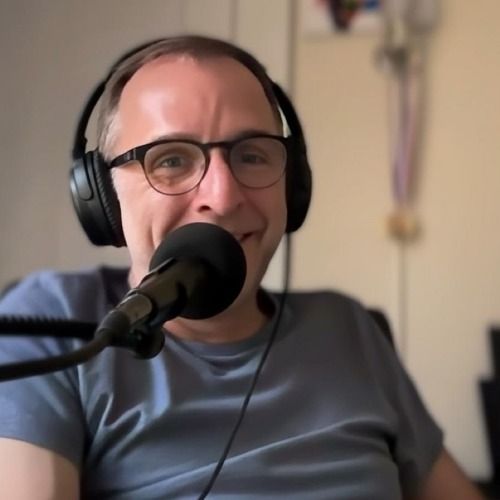
Episode 54
The Strange Freedom of Living Elsewhere with Chris Ryan (Re-Release)
Chris Ryan is the author of Sex at Dawn and host of Tangentially Speaking. We talk about living and traveling abroad, what happens when you get outside the American bubble, and how seeing other places can change the way you see your own country. We also get into my film Coverage, sex and death, 9/11, politics, Mexico, unemployment, podcasting, hitchhiking, and the unexpected connections that come from talking to people you might never otherwise meet.
(This episode was originally released on 12/11/2025.)
Subscribe to Tangentally Speaking here: https://chrisryan.substack.com/podcast and buy his book Sex at Dawn at fine bookstores everywhere.
Please show some support for the podcast and get access to some extra content by subscribing to the Patreon page: http://www.patreon.com/onefjef
Instagram: @onefjefpod
Facebook: https://www.facebook.com/onefjefpod
TikTok: @onefjefpodcast
YouTube: https://www.youtube.com/@onefjef
Email: onefjefpod@gmail.com
You can also call the podcast and leave a voicemail at 1-669-241-5882 and I will probably play it on the air.
Thank you for listening, please do it again, but on 9/11.
Onefjef is produced, edited & hosted by Jef Taylor.
Transcript
Hola, mis amigos y amigas.
Speaker:It's Jef.
Speaker:Hello.
Speaker:How are you doing?
Speaker:Are you doing well?
Speaker:Are you doing poorly?
Speaker:I hope you're doing very well.
Speaker:I hope you're thriving.
Speaker:As always, I use the word too often, but I think it's a great word, isn't it?
Speaker:Thrive, the T-H sound.
Speaker:It's a good one.
Speaker:It's Monday here in Mexico City.
Speaker:It's also Monday in United States of America and Canada and so forth and
Speaker:so on, but you under- you understand.
Speaker:I just want context for when I'm recording this.
Speaker:Monday at, uh, twelve twenty-five in the afternoon, August 3rd, perhaps.
Speaker:Si.
Speaker:Yo creo que si.
Speaker:This is the third re-released episode of onefjef, and I still haven't
Speaker:decided what I'm going to-- what episode I'm gonna re-release here.
Speaker:So it'll just be a surprise.
Speaker:So in…
Speaker:That's exciting for you and for me.
Speaker:It also gives me a, a good excuse not to talk about it in
Speaker:this, um, you know, prologue scenario, this introduction thing.
Speaker:So I, I won't have to do that because I don't know what it's gonna be.
Speaker:It'll be an episode that I've released with somebody or not.
Speaker:Maybe it'll just be me talking.
Speaker:I don't know.
Speaker:But it's gonna be good for sure because it's an episode of onefjef and as
Speaker:you all know by this point, every episode of onefjef is a wonderful
Speaker:episode of onefjef Except for one, but I'm not gonna tell you which one.
Speaker:They can't all be winners.
Speaker:Anyway, things in Mexico City are fine, if you're wondering.
Speaker:The weather's nice.
Speaker:It hasn't rained nearly as much as I was led to believe it would.
Speaker:Everybody said, "Oh, it rains so much in the summertime." And don't get me
Speaker:wrong, it's rained, but maybe this is a unusually light rainy season, but it
Speaker:has not rained every day by any means.
Speaker:Maybe it has, like, a tiny, tiny bit, but it's not been, like,
Speaker:schedule altering rain, right?
Speaker:And I'm kind of disappointed, to be honest, because I would-- I was
Speaker:kind of looking forward to schedule alter-altering rain, you know?
Speaker:And when it does rain, when there are these big storms that come through, I kind
Speaker:of enjoy it because, like, I can sit here in my apartment and look out the window
Speaker:and watch the rain pour down and it's very exciting, and lightning everywhere.
Speaker:Crazy electrical storms here when they happen.
Speaker:But I'm told that September, August are rainier months, although the
Speaker:metrics don't really support that.
Speaker:But we shall see.
Speaker:But it is fun here at my new apartment to be able to look out over the city and
Speaker:see the clouds developing into storms.
Speaker:It, like, satiates the little meteorologist in me.
Speaker:And it's interesting, I, I've yet to find a single app or website or anything
Speaker:that accurately has any seeming idea of what the weather's gonna be like here in
Speaker:Mexico City on any, any particular day.
Speaker:The temperatures are, you know, right-ish, but the rain forecast,
Speaker:it's like nobody has any idea.
Speaker:And I know there's still Doppler radar here, but not nearly as much.
Speaker:And I guess I didn't really appreciate how much more weather infrastructure there is
Speaker:in the United States and I guess Canada.
Speaker:I don't know, maybe.
Speaker:Or maybe I'm wrong about that, but I get the impression there's not nearly
Speaker:as much weather infrastructure here, and I don't know if infrastructure is
Speaker:the right word, but I'm going with it.
Speaker:I think it's also just a very difficult place, Mexico City, to forecast the
Speaker:weather because it's, you know, we're at seventy-two hundred feet, seventy-four
Speaker:hundred feet, and surrounded by mountains.
Speaker:So I think it's somewhat unpredictable, and I think that depending on where
Speaker:you are living, the forecast could be correct that day or could not
Speaker:be, because I think it's very-- It's like San Francisco in that sense.
Speaker:It's very hyper local.
Speaker:Like, it could be pouring rain, like, ten blocks away and be beautiful.
Speaker:Not beautiful, but cloudy right where I am.
Speaker:So
Speaker:But there have been a few nights where it's just been like, I think it was like
Speaker:four or five nights ago, it was just like raining all night, lightning, thunder.
Speaker:I loved it.
Speaker:I loved it
Speaker:So who knows?
Speaker:But the words rainy season, the descriptor rainy season does not
Speaker:feel accurate to me to describe the summer in Mexico City at this point.
Speaker:Like, yes, it does rain, but it doesn't feel like a rainy season per se because
Speaker:it doesn't rain until 5, 6, 7, 8 o'clock.
Speaker:And during the day, right now, it's beautiful blue sky, sunny.
Speaker:I mean, it's gorgeous out, 75 degrees, whatever.
Speaker:What, like 22, 23 Celsius, something like that?
Speaker:Yeah.
Speaker:And I'm indoors.
Speaker:And that's a paradox I've learned to live with, not a paradox.
Speaker:I think I overuse that word.
Speaker:It's a thing that I've had to get used to.
Speaker:And that is that I think I've mentioned this, but when I was living in Ohio,
Speaker:the weather in Ohio is very changing.
Speaker:One day it'll be cloudy.
Speaker:One day it'll be sunny.
Speaker:One day it'll be whatever, rainy, whatever it is, snowy.
Speaker:So when it's a sunny day, when it's a beautiful sunny day and you get up, you're
Speaker:like, well, I'm going to go out and do something because it's a beautiful day.
Speaker:But here, it's a beautiful sunny day almost every day when you wake up.
Speaker:So it's like you have to get over this weird guilt that you feel.
Speaker:Maybe it's just me from Ohio.
Speaker:But it's like, I feel like every time I'm inside when it's beautiful that I
Speaker:should be out there doing something, enjoying the wonderful weather.
Speaker:But it's every day.
Speaker:So I wonder how people like in LA feel about it because I feel like it's
Speaker:the similar weather situation in LA.
Speaker:I'll have to talk to some people from LA about this.
Speaker:I went to a Time Left dinner.
Speaker:Does anybody know what Time Left is?
Speaker:I'm sure some of you do.
Speaker:Time Left is this, uh, app that came out, I don't know, two, three,
Speaker:four years ago, and I did it in Columbus, Ohio, when I was there.
Speaker:It's basically like you sign up for the app and you, uh, they-- You sign up for
Speaker:a dinner and they basically just put you with like five other people, strangers.
Speaker:It's dinner with strangers.
Speaker:But you're like grouped together by, you know, profession or whatever, not
Speaker:the same to keep it interesting, right?
Speaker:And I did like, I don't know, two or three or four in Columbus, and they were fine.
Speaker:They were fine.
Speaker:It wasn't like mind-blowing.
Speaker:I didn't meet any like lifelong friends, but it was interesting.
Speaker:So then they have it here now, and my friend did it here and
Speaker:she was like, "Oh, it was great.
Speaker:We hung out all night." So I was like, "Oh, I should try that when I get
Speaker:back." So I signed up for one of the dinners and I went-- This was last week.
Speaker:And, uh, you know, you can put your language preference, so
Speaker:I just put Spanish and English because I kind of know Spanish.
Speaker:Not very well, but I kind of do.
Speaker:I ended up getting grouped for dinner with everybody, all, all Mexican people who
Speaker:just spoke Spanish, so it was difficult.
Speaker:I didn't really understand a lot.
Speaker:I didn't communicate a lot.
Speaker:I understood a little, and some of them spoke a little English, so they would try.
Speaker:But they were all very impressed that I'd only been learning Spanish for about
Speaker:six months, so that made me feel good.
Speaker:But it's exhausting.
Speaker:That's the thing that I always remember.
Speaker:Trying to understand a different language, it makes your brain work like three or
Speaker:four times as hard, and you don't realize it until you're like an hour or two in
Speaker:and you're like, "Oh, I'm just fucking exhausted. I'm just exhausted from
Speaker:listening and trying to communicate in a language that I don't speak very well."
Speaker:I'm sure it gets easier, but, um, but it was still a fun dinner, more or less.
Speaker:Más o menos.
Speaker:I'm doing it again, but I signed up for English speaking, which I'm hoping means
Speaker:that there will be some people who speak a little Spanish so that, you know, it'd
Speaker:be nice to have language exchange, right?
Speaker:Anyway, I guess that's about it of what's going on here.
Speaker:Um, I mean, I could go on, but then we get into a whole full episode, and I
Speaker:don't even know what-- I still gotta figure out what episode I'm gonna
Speaker:be playing after I talk right now.
Speaker:But don't worry.
Speaker:I'll, I'll do it.
Speaker:I'll get through this.
Speaker:Anyway, "What do you have to do now, Jef?" I have to go return an Amazon
Speaker:package, and it's a great story, so I'll tell it to you before I go here.
Speaker:You know, I, I enjoy a smoothie in the morning.
Speaker:I do enjoy a smoothie, and my last apartment here had a, um, blender.
Speaker:And there was a blender here too, but the blender, when I tried to use it the first
Speaker:time, it did not… It worked, but the blending container had a profound leak in
Speaker:it, so it made a mess all over the floor.
Speaker:So I thought, "Well, what am I going to do? I cannot make a smoothie
Speaker:without a blender of some sort." So I went onto amazon.mx, which
Speaker:is interestingly not amazon.com.
Speaker:I mean, it's not-- I don't know how it's affiliated with Amazon.
Speaker:Amazon, I-- It's a strange partnership with Amazon Mexico, but doesn't matter.
Speaker:And I found…
Speaker:It's different products for sure.
Speaker:And so I found a, like a smoothie blender, like a small one, and I was like,
Speaker:"Oh, it's only, you know, 250 pesos." That's like, whatever, 20, 30 bucks.
Speaker:No, that's actually… No, it's only like 12 or $15.
Speaker:Wow, it was cheap.
Speaker:Well, that explains everything, doesn't it?
Speaker:Because it's a piece of crap.
Speaker:I got this thing, and it is a piece of absolute garbage to a
Speaker:degree that's like it shouldn't even have been made as a product.
Speaker:It's just a waste But some of the reviews, they seem happy.
Speaker:But then how can you-- You don't trust reviews anymore.
Speaker:Who trusts reviews, even in Mexico?
Speaker:And here's the funny thing.
Speaker:I wrote a review about this pla- thing, you know, for Amazon to warn other
Speaker:people because there weren't a ton of reviews, which was my mistake for buying
Speaker:a product with not a lot of reviews.
Speaker:But I thought I should warn other potential, you know, purchasers
Speaker:of this piece of crap blender.
Speaker:And this has happened twice now.
Speaker:And I wrote a pretty solid review.
Speaker:I mean, it was not nice because it's a piece of crap blender, so I was honest.
Speaker:And a few days later, I get an email from amazon.mx that says,
Speaker:"W-- Your review was rejected because it was, I think, too mean."
Speaker:Like, they don't allow really mean reviews on Mexican Amazon.
Speaker:So I'm just not gonna bother writing reviews anymore, but I am gonna return
Speaker:this piece of crap blender today.
Speaker:So that's exciting for me, and it's exciting for you, and it's not exciting
Speaker:for the blender company because they're probably getting a lot of returns
Speaker:based on the quality of their product.
Speaker:I imagine a lot of people just don't return it because it's only, you know,
Speaker:two hundred and fifty pesos, and they're like, "Well, whatever. It's-- Like, I
Speaker:don't have time to walk to the place where I have to get it returned at." But I do
Speaker:have time, and I'm gonna get my ten two hundred and fifty pesos back, damn it.
Speaker:The end of that story.
Speaker:Did you enjoy it?
Speaker:I hope you really did.
Speaker:And, um, finally, now that I'm thinking about it, I think I mentioned that I
Speaker:did hire a lawyer to try to recover my deposit from my last apartment.
Speaker:Uh, that was about two weeks ago.
Speaker:He sent a strongly worded legal letter demanding, you know, a
Speaker:demand letter, I guess they call it.
Speaker:And, um, m- no response to that at all.
Speaker:And then I emailed the lawyer, I guess it was last Monday, and was like, "Hey, what,
Speaker:what do we do now if he's not responding?" And he's like, "Okay, I'll call him.
Speaker:I'll try calling him." So I don't know what's going on, but it's
Speaker:not looking good, my friends.
Speaker:It's not looking like I may not-- It's looking like I may not get my
Speaker:deposit back, which is okay, but it makes me angry when the bad people win.
Speaker:And I'm not saying that my former landlord is a bad person necessarily,
Speaker:but in this case he is, and I don't like to be screwed over like that.
Speaker:'cause I'm legally right here.
Speaker:But the question becomes how much money do I spend to recover 21,000 pesos?
Speaker:I don't know.
Speaker:It's a decision I have to make.
Speaker:But for now, I'm just gonna play this wonderful from the archive,
Speaker:from the vault episode of onefjef.
Speaker:It's a great episode.
Speaker:It's one of my favorites.
Speaker:It's got highs, it's got lows, it's got sidewayses, and all sorts
Speaker:of different directions that I think you're really gonna enjoy.
Speaker:No, nay, I know you're going to enjoy it.
Speaker:You will.
Speaker:You will enjoy it.
Speaker:And I'll be back in about two weeks with a brand new episode of onefjef.
Speaker:Until then, continue thriving, my friends.
Speaker:Be well.
Speaker:Be happy.
Speaker:Take a deep breath and let that shit go How did you find out that these doctors
Speaker:were, like, sexually, um, like, open?
Speaker:By having sex with them.
Speaker:Fair, fair enough.
Speaker:That is fair enough.
Speaker:At least some of them.
Speaker:Okay.
Speaker:Case study.
Speaker:This is episode 28 of onefjef.
Speaker:28 sits at a strange crossroads, a perfect number that ancient mathematicians
Speaker:treated with awe, and the capstone of a four-cycle run long seen as
Speaker:the threshold into real adulthood.
Speaker:It shows up in the body's lunar-leaning 28-day rhythms that shaped early
Speaker:timekeeping and folk magic, and in Kabbalah, it matches Koch potential,
Speaker:giving 28 the feel of a quiet engine number, one that completes a cycle and
Speaker:hands you the power to move forward.
Speaker:Hello, my friends.
Speaker:Jef Taylor here, back in my makeshift recording studio here in Columbus, Ohio.
Speaker:I did not have a guest for this week's episode either, but fortunately, I
Speaker:heard from Chris Ryan earlier today, and he said he's going to release
Speaker:the episode that I recorded with him
Speaker:for his podcast tomorrow.
Speaker:And I asked him if he could send me the audio so I could release it on my
Speaker:podcast as well, and he graciously agreed.
Speaker:So I'm going to release this conversation on my podcast tomorrow because it is
Speaker:more of a conversation than it is an interview, and, uh, I think it suits
Speaker:both of our podcasts in that sense.
Speaker:So in a sense, my guest today is Chris Ryan.
Speaker:Chris Ryan is an author and podcaster best known for Sex at Dawn, where
Speaker:he argues that early humans lived far more cooperatively and less
Speaker:monogamously than we assume today.
Speaker:He has a PhD in psychology, a taste for dismantling tidy modern narratives,
Speaker:and a podcast called Tangentially Speaking, where he follows his
Speaker:curiosity into conversations about culture, evolution, and how mismatched
Speaker:we often are with the world we built.
Speaker:I'm truly grateful to have had the opportunity to meet and
Speaker:be on Chris Ryan's podcast.
Speaker:I've been a fan for, uh, several years, and, uh, yeah,
Speaker:it just kinda randomly happened.
Speaker:Life is random sometimes.
Speaker:Patreon subscribers, thank you so much.
Speaker:I appreciate your continued support as always.
Speaker:I'll be posting some more exclusive content for you in
Speaker:the next week or two or three.
Speaker:If you yourself would like to support the podcast, help me buy some more
Speaker:Christmas gifts, help me get by in this holiday season without a job,
Speaker:please go to patreon.com/onefjef and sign up for as little as $5 a month.
Speaker:$5 a month, that's nothing.
Speaker:But please don't use your iPhone to do it.
Speaker:Subscribe on the Patreon page because Apple takes 30% of all
Speaker:donations made through the Patreon app because Apple is greedy.
Speaker:Sorry, Apple, you are.
Speaker:I hope that doesn't hurt my algorithm.
Speaker:Help support the podcast, help support me, and get some exclusive content.
Speaker:Patreon.com/onefjef.
Speaker:Thank you very, very much.
Speaker:And now you can pause the podcast for a moment, go to your computer, and do that.
Speaker:Okay, thank you very much.
Speaker:Anyway, I hope you enjoy this conversation with Chris as much as I enjoyed having it.
Speaker:Thank you for listening.
Speaker:Thank you for being here.
Speaker:Here is me and Chris Ryan sitting outside his house in Crestone, Colorado,
Speaker:overlooking the San Luis Valley
Speaker:All right, ladies and gentlemen.
Speaker:Uh, I'm sitting in the morning sun here in Crestone, Colorado, with one Jef Jef.
Speaker:onefjef.
Speaker:onefjef, not one Jef Jef.
Speaker:onefjef
Speaker:Jef.
Speaker:onefjef Taylor.
Speaker:Uh, and this'll be an interesting podcast because I don't remember exactly
Speaker:what it is that I found so interesting about you when we met for a beer.
Speaker:But I do remember thinking, "Oh, I should do a podcast with that guy. He's
Speaker:interesting." I did watch your film.
Speaker:Oh, which one?
Speaker:Uh, didn't you send me Coverage?
Speaker:Coverage.
Speaker:Oh, the 9/11 one, yeah.
Speaker:Right.
Speaker:Yeah.
Speaker:I remember the quote.
Speaker:I wrote down the quote too.
Speaker:I remember there's a… You were asking me what, what inspired me to make
Speaker:that, and there was a Burroughs quote.
Speaker:What was it?
Speaker:Um, "Sexual arousal results from the repetition and, and impact of
Speaker:image." It's kind of a… And that and the movie Crash by Cronenberg.
Speaker:You ever see that one?
Speaker:People who get sexually aroused by car crashes.
Speaker:I've never seen that.
Speaker:Uh, it's quite… People hate it, but I actually loved it.
Speaker:Um, but it's not a well-liked Cronenberg film by any means.
Speaker:W- wasn't there a film called Crash that won the Oscar?
Speaker:Yeah, not that one.
Speaker:I've seen that one.
Speaker:Yeah, that was a controversial one.
Speaker:That was controversial.
Speaker:Yeah.
Speaker:Yeah.
Speaker:But this one, uh, this one's controversial, but nobody saw
Speaker:it, so it can't be… I mean, they're like, you know, blood and
Speaker:semen mixing on the car seats.
Speaker:Right.
Speaker:The book's actually even better.
Speaker:Cronenberg's a little intense.
Speaker:He can be, sure.
Speaker:Yeah.
Speaker:Um, okay, but let's talk about that quote a little bit, 'cause
Speaker:I, I watched the film and I was…
Speaker:It, it's, it's very interesting.
Speaker:It's a-
Speaker:A couple… It opens with a, what seems to be erotic failure.
Speaker:Yeah.
Speaker:The guy can't get it up or can't come or something.
Speaker:Yeah, yeah, yeah.
Speaker:And so there's this sort of like impasse and awkwardness and all that, and then
Speaker:9/11 happens, and he finds his mojo watching the Twin Towers come down,
Speaker:and then the, you know, drama ensues.
Speaker:But so Burroughs quote that, that eroticism or erotic charge comes
Speaker:from repeated viewing of an image.
Speaker:Yeah, yeah, yeah, repetition and, uh, repetition and impact of image.
Speaker:Yeah.
Speaker:But, but what image?
Speaker:Not just any old image.
Speaker:Right.
Speaker:Right?
Speaker:Right.
Speaker:I mean, an image of a naked woman, okay, uh, but… And also,
Speaker:okay, so two, two, two things.
Speaker:What kind of image, and also I would think that that would be less applicable
Speaker:to women than to men, given that women's sexuality is less visual than men's.
Speaker:Sure.
Speaker:I agree with that.
Speaker:I mean, I think it was that quote combined with the somewhat phallic
Speaker:nature of the World Trade Center- Yeah … and the fact that they were
Speaker:playing it, I mean, that week or two, I mean, it was all day, every day.
Speaker:They were playing that footage.
Speaker:America under attack.
Speaker:I mean, it was unbelievable.
Speaker:Yeah.
Speaker:Um, like literally, the whole week you couldn't watch anything, but, but
Speaker:the World- The fragmented statement appears to be referencing the widespread
Speaker:media coverage following the September 11th- … 2001 attacks on the World
Speaker:Trade Center, indicating that news related to the event- Fuck you.
Speaker:Shut the fuck up What happened?
Speaker:You gotta leave that in.
Speaker:That's weird AI just chimes in.
Speaker:That's weird.
Speaker:It, it kept recording while that happened.
Speaker:Well, I hope it got it.
Speaker:That was very strange.
Speaker:Ugh, okay.
Speaker:Well, if, if it's recorded- … I guess we'll leave it.
Speaker:Yeah, you gotta leave that one in.
Speaker:Uh.
Speaker:Fucking technology is jumping out.
Speaker:AI is, AI's invading your podcast.
Speaker:That's never happened before.
Speaker:Uh, yeah, I was in Spain when it happened, so I didn't, I wasn't subjected to that.
Speaker:Oh, well, good for you.
Speaker:But it's interesting to think that the collapse of the World
Speaker:Trade Center would be phallic.
Speaker:I would think that would cause more erectile dysfunction than- Well, it's
Speaker:than erectile.
Speaker:Yeah, I guess that's, I guess that's a valid… They could probably make it
Speaker:into some sort of an erectile dysfunction commercial if they really wanted to.
Speaker:Yeah.
Speaker:Do you remember, uh- Soon.
Speaker:Soon … when they first opened the, um, the World Trade Center, the new museum,
Speaker:the new tower- Yeah … and the museum in there, for the, the very beginning
Speaker:they sold a, like, a, a United States shaped cheese platter, and it had,
Speaker:like, the dots where the planes had hit.
Speaker:On a cheese platter?
Speaker:Yeah.
Speaker:Yeah, they got rid of it pretty quickly.
Speaker:I guess they're collector's items now.
Speaker:I don't know.
Speaker:It was very misguided.
Speaker:How could, how could you collect a cheese platter?
Speaker:That would- But I mean, just to use that 9/11 on a cheese platter, it
Speaker:seems like if you bring that out at a party it's not gonna lift the mood.
Speaker:It's gonna be like, "Oh, well, that's a…" Yeah.
Speaker:Yeah.
Speaker:Uh, did you like the movie?
Speaker:Yeah.
Speaker:Yeah.
Speaker:It, it, it was disturbing- Sure … certainly.
Speaker:My mom liked it, which made me happy.
Speaker:Oh, that's good.
Speaker:My dad, not so much.
Speaker:Yeah.
Speaker:What was your dad's complaint?
Speaker:He never really said… Like, he didn't really complain about it.
Speaker:I think he was just troubled by just the whole thing.
Speaker:My mom's quote was, that I'll always remember, she's like, "Honey, you nailed
Speaker:it. You nailed it." And I was like, "Oh, I'll take that, Mom. I'll take
Speaker:it." Uh- Well, what, uh… So what do you think, uh… To me it was, um, it
Speaker:kind of, um, spoke to the Freudian, you know, Eros and Thanatos, the, the death
Speaker:impulse and the erotic impulse- Sure
Speaker:being intertwined.
Speaker:Sure.
Speaker:Sure.
Speaker:Um, you know, and it made me think about when I worked in hospitals
Speaker:in Spain, I found, um, you know, in Spain a lot of doctors are, are women.
Speaker:Mm.
Speaker:I found in, I really enjoyed working in hospitals and, and hanging
Speaker:out with doctors because they seem to be uninhibited sexually.
Speaker:Really?
Speaker:And we talked about, like, "Why are you so uninhibited compared to the
Speaker:normal Spanish person?" And generally, their take was when you're around
Speaker:death, you lose sexual inhibition.
Speaker:Huh.
Speaker:That's interesting.
Speaker:Because there's something about sex that's very … It's about life, right?
Speaker:Right, right, right, right.
Speaker:Eros is life force.
Speaker:It's all there, yeah.
Speaker:And so when you're around
Speaker:death, there's an impulse to- Yeah … cultivate the life force.
Speaker:Huh.
Speaker:How did you find out that these doctors were, like, sexually, um, like, open?
Speaker:By having sex with them.
Speaker:Fair, fair enough.
Speaker:That is fair enough.
Speaker:At least some of them.
Speaker:Like a case study.
Speaker:The women.
Speaker:Um, yeah.
Speaker:No, I, I was doing research around, uh, I was doing a ph- a PhD research, uh,
Speaker:where I was specifically studying, um, the doctors who deal with a lot of death.
Speaker:So oncologists and emergent or, um, intensive care- Mm … physicians.
Speaker:And so I was interviewing them and, and then I was teaching
Speaker:English, so I would sp- I would, you know, focus my, uh, teaching.
Speaker:So I'd, I'd take students who were working in specializations
Speaker:that I found interesting.
Speaker:Mm-hmm.
Speaker:And so I met a lot of them, and we talked a lot and, uh, um…
Speaker:Yeah, it, it, it's interesting.
Speaker:And then I've spoken to other people who, you know, talk
Speaker:about war being very erotic.
Speaker:Right, I could s- Um, you know … I see that
Speaker:a- any kind of, anything where there's a lot of drama and, and, um,
Speaker:life or death stuff seems to reduce inhibition and increase libido.
Speaker:I shoulda had you come speak at one of the Q&As for the film.
Speaker:You could have- … explained it better than I did.
Speaker:Wow.
Speaker:Uh, it's funny that m- That's just my take on that whole-
Speaker:No, it's an interesting take.
Speaker:Um, I had a lot of interesting reactions to that film.
Speaker:Uh, the people that did walk out of the theater, um, people would write me.
Speaker:I got, like, emails.
Speaker:People would write me, and some people were, like, had, like… You know, once
Speaker:you finish a film, it's not yours anymore, so whatever I think it is, you know.
Speaker:Um, and some people's interpretation of it was really, uh, there were some very
Speaker:unique interpretations of, of the film.
Speaker:Um, but it didn't do terribly well on the festival circuit.
Speaker:We got into a lot of erotic film festival, like the Porn Film Festival
Speaker:in Berlin or something, which is very big- Hmm … uh, apparently.
Speaker:And, like, we were in the CineKink, and, uh, that's a touring, a traveling,
Speaker:uh, erotic, um… And, like, we played right after, like, this…
Speaker:I've never experienced this before in my life, but, like, you
Speaker:know, our block, I don't know.
Speaker:B- right before our movie, there was, like, we walk into the theater,
Speaker:and it's just a big, you know, full screen just, just fisting.
Speaker:Right.
Speaker:Yeah, yeah.
Speaker:Which- Yeah, I don't think, I- I'm not surprised it didn't do well 'cause
Speaker:it's not a, it's not a porn film.
Speaker:It's not a ro- I mean, there is eroticism, but it's- It's not sexy … it's complex.
Speaker:Yeah.
Speaker:Yeah.
Speaker:Yeah.
Speaker:Yeah.
Speaker:Did, did you get accused of making light of 9/11?
Speaker:Yeah, and I could always, like… I mean, my argument there was,
Speaker:like, well, I mean, is it my… I'm just, I'm just pointing a finger.
Speaker:A lot of it was also about the mass media's, like, you know, um,
Speaker:you know, oversaturation of the…
Speaker:So a lot of my argument was, like, well, no, it's actually, what I was pointing
Speaker:a finger at is more the mass media.
Speaker:Is it me that, or is it the mass media that was playing it over and
Speaker:over and over and over and over?
Speaker:Right.
Speaker:Um- Yeah … but it wasn't a lot of that, actually.
Speaker:Yeah.
Speaker:Uh, but yeah, but it almost got into Sundance, so that was, um- It was good
Speaker:to find out that it almost got in.
Speaker:Yeah.
Speaker:Yeah.
Speaker:Yeah.
Speaker:Is that the only film you've made, or…?
Speaker:No, I've made, I mean, uh, a handful.
Speaker:Um, yeah, the one I made after that was, uh, that, that got into Sundance,
Speaker:and that was like, I'd gone through a horrible breakup, um, with the
Speaker:actress that was in Coverage actually.
Speaker:Oh.
Speaker:Um, and, uh, and the, the actor who was in Coverage went through a horrible
Speaker:breakup as well, so we got together and just decided we're gonna make some very
Speaker:quick and easy thing improvised, and, uh, had no real intent to make it anything.
Speaker:We were gonna make a feature, but we never finished it, so
Speaker:I just made it into a short.
Speaker:Spent, like, 500 bucks and, you know, edited it a lot, and then, yeah,
Speaker:submitted it to a bunch of festivals.
Speaker:One festival took it, then nobody else, and then Sundance took it.
Speaker:And, um- And what's it about?
Speaker:It's basically just a, a guy in his, like, mid to late 30s.
Speaker:It's a very, um… it's, like, more of a mood piece than a… But it's a guy
Speaker:in his mid-30s just kind of struggling to come to terms with the end of his
Speaker:relationship that he thought was going to go on, and trying to figure out what
Speaker:his life looks like post-relationship, and understands the nature of the, of the
Speaker:breakup and why and so forth and so on.
Speaker:And then he takes flight classes and flies a plane into a building?
Speaker:There you go.
Speaker:Yeah, that, that's Coverage Part Two.
Speaker:Yeah.
Speaker:Yeah.
Speaker:Right, right.
Speaker:Yeah.
Speaker:The sequel.
Speaker:Uh, yeah, that could be a prequel, actually, maybe.
Speaker:Yeah.
Speaker:Yeah.
Speaker:Right.
Speaker:'Cause, like, we had, we had a jokey idea to do a sequel.
Speaker:Um, yeah, we had all sorts of…
Speaker:That was a funny film to make, 'cause, like, the jokes that we would make,
Speaker:like disasterbating was the term we came up with for the- Disasterbating.
Speaker:Disasterbating, yeah.
Speaker:Yeah, yeah.
Speaker:Yeah.
Speaker:I mean, I wonder if there is an erotic component to- To what's going on.
Speaker:I, I mean, I know you worked in politics for a while, so I wanted to get some of
Speaker:your thoughts on the political scene.
Speaker:But, you know, as we're speaking, it's what, Tuesday?
Speaker:Mm, yeah, twenty-first, I think.
Speaker:Um, after the No Kings marches on Sunday- Uh-huh … which Trump responded
Speaker:to by releasing an AI film of himself bombing American cities and shit.
Speaker:Shit.
Speaker:Yeah, amazing times we live in.
Speaker:I mean, who… Honestly, at a certain point I feel like you just have to like
Speaker:I mean, it's, it's a sad laughter, but it's a laughter still.
Speaker:Like it's like, I mean, how far off the rails can this country go?
Speaker:Um, yeah.
Speaker:Yeah, I mean, I could, yeah.
Speaker:Um, yeah, it's scary.
Speaker:I don't know.
Speaker:I don't know what's gonna happen.
Speaker:I feel like there's so many things happening, you know, they say fl-
Speaker:they're flooding the zone, you know?
Speaker:So- With shit Right.
Speaker:Exactly.
Speaker:Yeah.
Speaker:Exactly.
Speaker:Um, and, and it really works.
Speaker:It works very effectively because the things that happened even three
Speaker:months ago, it's like I don't even remember a lot of those 'cause
Speaker:it's one thing after the other.
Speaker:Um, underneath it all though I think, I was talking to a friend of mine from
Speaker:the Lincoln Project, um, my podcast a couple, couple weeks ago, and she was
Speaker:basically saying that, um, you know, Trump is more like a cudgel, right?
Speaker:It's really easy for, for the Democrats to use Trump.
Speaker:Like the organization we worked, like Lincoln Project that we worked
Speaker:for who I'm a little bit leery of saying but, 'cause I signed an NDA,
Speaker:but if I don't say anything bad about them, I think we're in good shape.
Speaker:The argument was always democracy versus Trump, right?
Speaker:Mm. But like what even is democracy in America anymore?
Speaker:Like do we have a democracy?
Speaker:Like when's the last time we had a real democracy in America?
Speaker:Um, and it's like
Speaker:Trump is a very convenient figure to make the, the overall enemy,
Speaker:but really it's a systemic problem.
Speaker:It's a systemic collapse problem, and I think the Democrats are almost
Speaker:just as comfortable using Trump as a cudgel as, as the Republicans
Speaker:are to use him as their tool to get everything they've ever wanted.
Speaker:Um- But it's not everything they, they've ever wanted.
Speaker:The, the wants are new, right?
Speaker:What Republicans used to want was conservative.
Speaker:Yeah.
Speaker:And Trump's anything but conservative.
Speaker:I think some of them, sure.
Speaker:But I think there's a certain handful of them that have had, like, a long list
Speaker:of things, like, what is Project 2025 or whatever it is, um, have had a long list
Speaker:of things that they've wanted to get done, and they just needed, like, a, like, a
Speaker:clever buffoon to put in there as the figurehead, and then they can behind the
Speaker:scenes just kind of do whatever they want.
Speaker:Yeah.
Speaker:Um- Similar to the Reagan administration.
Speaker:Yeah, yeah.
Speaker:Another- Yeah … sort of TV- Right … screen presence to attract attention
Speaker:while we do our things behind the scenes.
Speaker:Right.
Speaker:That's actually interesting.
Speaker:Um, I think this is, like, times 10.
Speaker:Yeah.
Speaker:I mean, it's crazy that they had the same… Isn't it both Make,
Speaker:Make America Great Again was both of their slogans, wasn't it?
Speaker:It was Morning in America.
Speaker:Morning in America.
Speaker:Same, same thing.
Speaker:Same kind of a- I don't remember any baseball hats, but- Right.
Speaker:No … it was a lot of the same kind of racist rhetoric.
Speaker:I went to the Trump store in, uh, Branson, Missouri.
Speaker:I was on my road trip across the country, and I, I went to the,
Speaker:you know, I went to Branson.
Speaker:Because you ever been to Branson, Missouri?
Speaker:Never been.
Speaker:It's something to see.
Speaker:It's something to see.
Speaker:Um, yeah, it's like a combination of, like… It's like a combination
Speaker:of Las Vegas, Niagara Falls.
Speaker:Um, I mean, it's in the, it's in the, um, the Ozarks, so it's
Speaker:like, you know, it's pretty.
Speaker:But, you know, I think there's, like, 30 mini golf courses in the area.
Speaker:There's, like, a whole replica of the Titanic.
Speaker:It's a strange town.
Speaker:And every… Remember Yakov Smirnoff?
Speaker:Yeah.
Speaker:Yeah.
Speaker:I thought he was dead.
Speaker:I didn't even know he was alive.
Speaker:He's got a comedy club there called S- uh, Yakov's.
Speaker:I was gonna go see him, but, uh, he wasn't doing that night.
Speaker:Uh- Russia's not funny anymore.
Speaker:And what's he doing now?
Speaker:Yeah.
Speaker:That's the question.
Speaker:Like, you know, uh- Yeah … what is he doing, uh… Yeah.
Speaker:Anyway.
Speaker:Yakov Smirnoff.
Speaker:Wow.
Speaker:Yeah.
Speaker:And they have more, more theater seats than, uh, New
Speaker:York City in Branson, Missouri.
Speaker:And, and what… It's, like, Grand Ole Opry kinda shit?
Speaker:It's all… It's, like, wash… It's a lot of washed-up, um,
Speaker:I think, uh, old stars that…
Speaker:But yeah, I think it's, like, after you go on the Grand Ole
Speaker:Opry, maybe you go to Branson and just- Right … do, do a run there.
Speaker:Yeah.
Speaker:Like, like you're not, you're not up to Vegas.
Speaker:Yeah, something like that.
Speaker:And you're kinda like- Jef Foxworthy kind of- Well, your appeal is there.
Speaker:Like, it's, uh, it's a different appeal than Vegas.
Speaker:Like, it's a different… You know, it's the South, so, um- Mm-hmm.
Speaker:Yeah … you know, it's southern Missouri.
Speaker:Yeah.
Speaker:Anyway, there's a Trump store there.
Speaker:There's actually two.
Speaker:So I was like, "All right, I gotta…" You know, you only know how many
Speaker:times you get to go to a Trump store.
Speaker:And, uh, yeah, it was something else.
Speaker:I mean, it was crowded.
Speaker:There's an animatronic Trump outside, like, you know, waving at you, all
Speaker:sorts of… And all the hats, you know, Golf of America, blah, blah, blah.
Speaker:And then the one hat that I noticed- … 'cause they're all Trump slogans, you
Speaker:know, Make Amer- Spelled with an O, Golf of America … Golf of America.
Speaker:Baron for president.
Speaker:Um- Great
Speaker:and then one of them just, just one of them just said, "Titties." But it was in,
Speaker:like, you know, it had an American red, white, and blue, like- This is a shirt?
Speaker:No, it was just a hat.
Speaker:Oh, a hat?
Speaker:It just said titties.
Speaker:Yeah.
Speaker:Titties.
Speaker:Titties.
Speaker:Yeah.
Speaker:Well, how can you argue with that?
Speaker:No.
Speaker:No.
Speaker:It was the only one that was unrelated to politics or Trump, which was interesting.
Speaker:Yeah.
Speaker:Almost bought it, but thought- … no, no.
Speaker:$40 for a titties hat.
Speaker:And where are you gonna wear it?
Speaker:When am I gonna wear that?
Speaker:Yeah.
Speaker:Yeah.
Speaker:Yeah, for Halloween maybe, but even then, yeah.
Speaker:When?
Speaker:What are you going as?
Speaker:Right.
Speaker:I mean- A Hooters manager?
Speaker:Like… I don't even know if a Hooters manager would wear…
Speaker:I mean, that's a little…
Speaker:Uh, some of them would, I would think.
Speaker:Uh, and then there's a Jesus store right down the street from the Trump
Speaker:store- Yeah … which I went to as well.
Speaker:A Jesus store.
Speaker:It's like Jesus merch, right?
Speaker:It's all Jesus merch.
Speaker:And it's, like, very similar to the Trump store.
Speaker:Um- Oh, man … very surprisingly similar to the Trump store actually.
Speaker:It's just a different character.
Speaker:So have you been paying attention to politics- Mm … your whole life
Speaker:or, I mean, you mentioned that you worked for the Lincoln Project.
Speaker:Yeah.
Speaker:We don't… W- we can talk about that or not, depending on your comfort level.
Speaker:But was- … was your work with them because of an interest in politics,
Speaker:or it was just a job and you're a video editor and there you go?
Speaker:Um, yeah, it really kind of randomly happened.
Speaker:I've certainly… Like, I've paid attention to politics for a good
Speaker:portion of my life on and off.
Speaker:I mean, a… You know, during Obama I didn't really 'cause you
Speaker:didn't really, I guess, have to as much because it was just, you
Speaker:know- Kind of normal … um- Yeah.
Speaker:Uh, but yeah, no, I got, I got…
Speaker:During COVID, it was 2020, I got laid off.
Speaker:I was working in, uh, uh, uh, marketing at Hollister, like the, the clothing.
Speaker:We're selling clothing, jeans to teenagers.
Speaker:Um- Right, Hollister, which is a tiny town in Cal- in California.
Speaker:Yeah, and they've had… Though they, they, it's not based on that.
Speaker:That's not at all what the clothing brand is based on.
Speaker:I think there were some sort of a lawsuit settlement or something- Um, yeah
Speaker:… that the thing- I remember reading something like that … yeah, yeah.
Speaker:Something, something.
Speaker:Yeah.
Speaker:Yeah.
Speaker:Well, Abercrombie & Fitch has had their own share of
Speaker:problems, and that's the parent.
Speaker:Okay.
Speaker:Yeah.
Speaker:Right.
Speaker:Um, but, uh, but yeah, I got laid off from there during that
Speaker:summer, and a buddy of mine…
Speaker:And this was when the Lincoln Project was just starting to get really big.
Speaker:And a buddy of mine from New York, like, called me and he's like, "Oh,
Speaker:I know a guy at the Lincoln Project. They're looking for somebody." And
Speaker:weirdly enough, I'd already been making, like- weird Trump mashups.
Speaker:You know, I made just weird videos for The Lincoln Project, like funny, weird,
Speaker:you know, satirical blah, blah, blah.
Speaker:Mm. And I'd already made some weird things, um, when… I, I
Speaker:don't really know why, but it felt, you know, uh, it felt fun.
Speaker:I don't know.
Speaker:Um, anyway, so I already had work to show them, and so yeah, I was only
Speaker:supposed to work there for three months, and, um, and it was crazy.
Speaker:I've never had so much, um, like, you know, as a video person, you
Speaker:don't, you know, it's about how many people see your thing, right?
Speaker:To a great degree.
Speaker:And like the first thing I made was like, goes up online, it's like a million
Speaker:people have watched it in five hours.
Speaker:Mm. And it was just like, "Whoa, dude." Um, so that was fun.
Speaker:And, uh Yeah, but no, never intended to get in, uh, to politics
Speaker:and don't plan to do that again.
Speaker:Um, four and a half years was enough.
Speaker:Why is that?
Speaker:It's a complicated, uh, question.
Speaker:But, um, A, I would say primarily because my job required me to, like, watch… Um,
Speaker:I've, I've seen more Trump speeches than probably most people- Mm. -on the planet.
Speaker:Right.
Speaker:Um, like I know his bits.
Speaker:I would watch him hone a routine, you know, this, you
Speaker:know, the toilets don't flush.
Speaker:He would, he would hone that and get laughs from that.
Speaker:He's a stand-up comic at heart when he does these rallies.
Speaker:Um, and in watching CPAC, you know, CPAC- Mm-hmm.
Speaker:-I'd have to watch the whole, the whole weekend would be
Speaker:blocked off to just watch it.
Speaker:Right.
Speaker:Yeah.
Speaker:That'll rot your brain.
Speaker:Right, right, right.
Speaker:Yeah.
Speaker:And so I know a lot, like, you know, I know, we're well familiar
Speaker:with who Charlie Kirk was.
Speaker:Like I know, knew all these people in the… And it just
Speaker:became, it became, yeah, it became hard to live in that darkness.
Speaker:Yeah.
Speaker:You know?
Speaker:Um, beyond that, like just not even just watching the right-wing content,
Speaker:it was more like just experiencing the, um, I feel like rot and
Speaker:grift that is politics in general, um, from the inside to a degree.
Speaker:Right.
Speaker:Was, um, yeah.
Speaker:So you did, in your experience, I, I know we, we have an NDA to- I'm walking on
Speaker:a fine line here … dance around here.
Speaker:Yeah, yeah.
Speaker:Um, but we're not, I'm not talking about the Lincoln Project specifically-
Speaker:Right … just your general insider's view- Sure, sure … of politics, uh,
Speaker:did not leave you inspired and hopeful.
Speaker:No.
Speaker:I mean, I… No.
Speaker:Um, I feel like, uh, a lot of politics is a, um, is a grift.
Speaker:Yeah.
Speaker:There's, there's a lot of people making a lot of money, um, off of
Speaker:politics and, um, and I think that's the heart of the problem with our
Speaker:political system in general is money.
Speaker:Yeah.
Speaker:Um, there's a, I think it was Mo- Missouri or Montana, I heard they're
Speaker:actually the state, um- Yeah, I heard that
Speaker:is trying, you've heard this, that they're trying to basically say, take,
Speaker:take, saying the corporations can't donate to… And that could hold up
Speaker:because the Supreme Court has a lot of precedent on states' rights, like, um-
Speaker:Right, and that, what, what was the, the, um, Supreme Court case that allowed
Speaker:co- that said money is free speech?
Speaker:And, um, Citizens United.
Speaker:Yeah.
Speaker:Yeah, that that's based on states- Uh, regulations of corporations.
Speaker:And so Montana's saying, "Well, then we can regulate that
Speaker:corporations are not allowed to spend money on politics." Mm-hmm.
Speaker:And apparently that's totally within the ju- Supreme Court judgment, so it doesn't
Speaker:even need to go back to the Supreme Court.
Speaker:Right.
Speaker:Although I'm sure they'll- That's interesting … I'm sure they'll
Speaker:find a way to make it, um- Yeah.
Speaker:Yeah, yeah.
Speaker:'Cause, you know, my concern is, like, in order to get money out of politics, you
Speaker:gotta find a candidate who's, you know, you know, an anti-corporate candidate.
Speaker:But, you know, 95% of the time the candidate with the most money wins.
Speaker:Yeah.
Speaker:So how do you even get the money?
Speaker:You need to find some s- insanely wealthy, um, you know, progressive,
Speaker:um, to, to actually run, but I don't know any insanely wealthy progressives.
Speaker:Who's willing to risk his life- Right … because if he gets close to winning-
Speaker:Then the, then the… Yeah, yeah.
Speaker:Yeah.
Speaker:They'll- The, the powers that be will move in They're not gonna let…
Speaker:Yeah, they're not gonna let anything that would truly change the system-
Speaker:Right … uh, in, into power.
Speaker:You know that Frank Zappa line that, uh, politics is the entertainment division
Speaker:of the military industrial complex?
Speaker:Mm-hmm.
Speaker:Right, right, right, right, right.
Speaker:I think about that a lot.
Speaker:Right.
Speaker:Yeah.
Speaker:I, I mean, I don't know.
Speaker:It… As cynical and jaded as I am about American politics, it does
Speaker:feel like what's happening now is something qualitatively different.
Speaker:For sure.
Speaker:You know, Obama was blowing up wedding parties in Yemen, but he
Speaker:wasn't releasing videos of himself shitting on Chicago, you know?
Speaker:It's- Right, right, right.
Speaker:Yeah, I mean, it seems like- There, there's a contempt to…
Speaker:And, and also it seems to me that they've already decided there
Speaker:aren't gonna be more elections- Yeah … so they don't give a fuck.
Speaker:It seems very much like they're trying to make this a one-party country.
Speaker:Um, and whether they can do that or not, I don't know.
Speaker:Like, there is some buffoonery in that administration-
Speaker:um, fortunately.
Speaker:Yeah.
Speaker:Um- No, well, well, that's the thing.
Speaker:It's like, it's like there's a pilot flying the plane who h- who is blind,
Speaker:drunk, and has no idea how to fly a plane.
Speaker:But yet I think there's a few people in there that aren't blind, drunk, or
Speaker:anything like that, and those are the ones that are really put- pulling the levers.
Speaker:Like, what's that, Steven Miller?
Speaker:Yeah.
Speaker:That guy's a demon.
Speaker:Um- Yeah … and he's the person who's doing most of this immigration madness.
Speaker:But, um- Yeah.
Speaker:But yeah, it certainly seems, it certainly seems like, uh- And you try to think
Speaker:of times in history that have been similar to how bad this is, and like
Speaker:I, I'm not very good with the history.
Speaker:I don't know.
Speaker:Um, but like wouldn't like early '20s, something like that?
Speaker:I mean, there were bad periods in America.
Speaker:I just, my question I guess is, when I, when I think about it, is
Speaker:like how do we get out of this?
Speaker:Like people, how do we re- return to normal?
Speaker:What does that even mean?
Speaker:How does that happen?
Speaker:I don't even, I don't see the country being able to do that.
Speaker:I think that it'll return to something, but whatever it is isn't
Speaker:gonna be what this, what normal, what we define as normal, right?
Speaker:Yeah.
Speaker:So I don't know.
Speaker:Um, I don't know.
Speaker:Yeah, it feels like we need to hit rock bottom.
Speaker:You know, when I think about times of significant change, like Teddy Roosevelt,
Speaker:uh, going after the monopolies- Mm-hmm
Speaker:and the big, uh, you know, railroad companies- Right, right … and
Speaker:all that in the early 20th century, you know, the, the country was
Speaker:at the brink of revolution.
Speaker:And then you think about, uh, you know, the sort of regulations coming into
Speaker:effect in the 1920s after Upton Sinclair wrote The Jungle, uh, describing the
Speaker:meat packing plants and the rats- Mm-hmm
Speaker:and the feces and all the shit.
Speaker:And then, okay, we'll do some regulation.
Speaker:Right.
Speaker:You know, and then FDR with the, the New Deal.
Speaker:Or was it the New- The New Deal, yeah.
Speaker:Yeah.
Speaker:Um, oh yeah, Great Society was Lyndon Johnson.
Speaker:You know, it's, it's like, I think there needs to be, the country needs to be on
Speaker:the verge of revolution before they'll…
Speaker:And then they'll just give you enough to quiet you down, you know.
Speaker:Right.
Speaker:I mean, it's also- Maybe a g- a war of some sort.
Speaker:I mean, some sort of a, a, a catastrophic event to cause a reset.
Speaker:Um- Yeah, yeah.
Speaker:But unfortunately, we'd have to live through that catastrophic event
Speaker:in order for the reset to happen.
Speaker:Uh- Yeah
Speaker:or if Trump dies.
Speaker:I mean, he's never gonna die though.
Speaker:He's gonna live till then.
Speaker:Motherfucker's gonna live till he's like 100 probably.
Speaker:I think he's like Lassie.
Speaker:I think they've got like- … 10 Trumps in, in- Right … the green room waiting-
Speaker:Right … to take- You might be right.
Speaker:You might be right … you know?
Speaker:Or if, if after he dies, he has like a Weekend at Bernie's thing
Speaker:where they just keep coming.
Speaker:Yeah.
Speaker:Like, carrying him around.
Speaker:He's got so much makeup, you wouldn't notice.
Speaker:Uh, but who jumps in?
Speaker:I don't know.
Speaker:I hope… I mean, uh, that's what people say.
Speaker:It's like once he's gone, they don't really have anybody to
Speaker:jump in, but I don't, I don't know that I agree with that.
Speaker:I feel like… Well, but like you said, he's, he's got so much stage presence
Speaker:and, and a twisted kind of charisma.
Speaker:Uh, I don't, I don't see anyone else, uh, in the wings who can h- who
Speaker:can command that kind of attention.
Speaker:No.
Speaker:JD Vance is a weasely little fuck.
Speaker:He really is, yeah.
Speaker:Everyone knows it.
Speaker:Yeah, yeah.
Speaker:He's, he doesn't inspire any- No, no … kind of fear or admiration.
Speaker:Yeah, I don't know.
Speaker:I don't know what the hell's happening, man.
Speaker:It's, that's why I live in the middle of nowhere.
Speaker:Yeah, it's a solid, it's a solid idea.
Speaker:Um, I kind of wanna get out of the country, but we'll see
Speaker:if I can make that happen.
Speaker:Well, weren't you living in Mexico City for a while or?
Speaker:I was like there for a month and a half or so- Oh … earlier this
Speaker:year- Right … after I lost the job.
Speaker:Um, yeah, I loved it.
Speaker:I'd never been to Mexico City.
Speaker:Had no idea what to expect, but boy, something going on down there.
Speaker:I really liked it.
Speaker:Yeah.
Speaker:Yeah.
Speaker:Yeah.
Speaker:It's a, it's a nice place.
Speaker:Beautiful place, wonderful people.
Speaker:Um, the warmth of like the, like, um, Latino culture really is like somewhat…
Speaker:Like as an American, it ta- at first it's like a little off-putting, and then you're
Speaker:like, "Oh, they really are that friendly."
Speaker:They're just… Um, I really like that.
Speaker:Yeah.
Speaker:Yeah.
Speaker:The vibes are better.
Speaker:Yeah.
Speaker:I've, I've spent a lot of time in Mexico.
Speaker:I like it a lot.
Speaker:It's hard… It's always hard for me to wrap my head around the evil Mexican
Speaker:assassins and, you know, the, the cartels and all that because my experience
Speaker:of Mexican people is, like- Yeah
Speaker:so kind and- Yeah … kinda simple- Mm-hmm … in a good way, you know.
Speaker:But I guess it's, that's similar to my experience of Africans as well, and
Speaker:they can… Man, if things go wrong in Africa- Right … shit gets really crazy.
Speaker:Right.
Speaker:Or even in America.
Speaker:I mean, I find most people I meet when I'm, you know, driving across the country,
Speaker:everybody's super friendly, you know?
Speaker:Mm. Um, but there's certainly a darkness.
Speaker:Yeah, I read something recently, I think it was on Substack.
Speaker:Somebody posted, "If you wanna hate America, watch the news. If you wanna love
Speaker:it, drive across the country." It's true.
Speaker:I drove across the country and I, and I met a lot of wonderful people actually.
Speaker:Yeah.
Speaker:I'd never done that before.
Speaker:It's a, it's a large country we have here.
Speaker:Really good.
Speaker:You've never driven across the country?
Speaker:No.
Speaker:I mean, when I was young, we, we drove with a family trip from like,
Speaker:you know, Ohio to Aspen, you know?
Speaker:But never like just, you know, all the way over to California and then down through.
Speaker:Um, yeah.
Speaker:And uh, you know, when I was unemployed, I'm still relatively unemployed, and
Speaker:I was like, "When else am I gonna have a chance to do this," you know?
Speaker:Mm. Um, and yeah, it was great.
Speaker:50 days.
Speaker:49 days.
Speaker:Oh, that's a… Okay, that wasn't an interstate highway drive.
Speaker:Yeah.
Speaker:That was a meandering drive.
Speaker:Yeah.
Speaker:And I wasn't moving the whole time.
Speaker:I was staying with some friends in like, um, uh, San Jose for a while.
Speaker:I stayed with my sister up in San, uh, San Francisco.
Speaker:Mm. And um…
Speaker:But yeah.
Speaker:And then went to, um, Bogota for a week.
Speaker:Um- But, uh, you been to Bogotá?
Speaker:Never.
Speaker:Traffic, traffic problems.
Speaker:Real bad traffic.
Speaker:I think it's, like, the worst traffic in, like, any major city in the, in the world.
Speaker:Mm. It's really pretty bad.
Speaker:Yeah.
Speaker:No, I always wanted to go to Colombia, but when I was doing a lot of traveling,
Speaker:uh, in the '80s, Colombia was- Yeah
Speaker:you know, off limits.
Speaker:People were getting kidnapped at the airport.
Speaker:Yeah.
Speaker:You know, you wouldn't even get to your hotel.
Speaker:Yeah, yeah, yeah, yeah.
Speaker:Yeah, like Medellín, they say it's a beautiful city now, but that
Speaker:was, like, the, like, the car- the headquarters there back in the day.
Speaker:Yeah.
Speaker:Yeah.
Speaker:Yeah.
Speaker:Yeah, no, beautiful city.
Speaker:I, I almost went four or five years ago.
Speaker:Uh, I was planning a trip there, and I had a friend whose wife … I guess
Speaker:his wife's Venezuelan, but first, he knows people in, in Colombia.
Speaker:Anyway, he was like, "Hey, I have a friend who has an apartment
Speaker:in Medellín, and let me ask him, you know, if you can stay there.
Speaker:I'd
Speaker:He's not … I know he's in London now," whatever.
Speaker:And then he got back to me, he's like, "Yeah, there's … You can
Speaker:stay in his apartment," he said.
Speaker:"It's, it's free." Yeah.
Speaker:You know, "Nobody's there, and da, da, da. And the doorman will
Speaker:let you in and all that." And so I got that far into the trip.
Speaker:Anyway, we ended up not going.
Speaker:I forget, some family shit came up or something.
Speaker:But, um, later I learned that his friend was the ex-mayor of Medellín.
Speaker:So, like, what, what kind of apartment did I turn down?
Speaker:Yeah, yeah.
Speaker:You must have turned down the most- Nice apartment.
Speaker:Right, right.
Speaker:Yeah.
Speaker:Well.
Speaker:Although also, do you wanna be staying in the ex-mayor's apartment?
Speaker:Like- Yeah … that's a- That's a complicated … What year was this?
Speaker:Five, six years ago.
Speaker:Oh, all right.
Speaker:Yeah.
Speaker:So it was, you know, not nearly as dangerous.
Speaker:I think maybe it was, like, early COVID.
Speaker:Maybe that's what came up.
Speaker:Oh, right.
Speaker:Like, it got- Right … you know … Yeah, 'cause we were
Speaker:pretty far into planning it.
Speaker:We were gonna go to Cuba first and then Colombia.
Speaker:Oh, I'd love to go to Cuba.
Speaker:Yeah, me too.
Speaker:I wanna go to North Korea.
Speaker:I do not.
Speaker:Yeah, I don't know what it is.
Speaker:I mean, I lived in Korea for, like South Korea, for a couple
Speaker:years when I was younger.
Speaker:And, uh, yeah, I'm just somehow f- I'm weirdly fascinated.
Speaker:Like, I've read a lot of books.
Speaker:I'm just weirdly fascinated with, you know, it's the most
Speaker:isolated country in the world.
Speaker:Yeah.
Speaker:And it, uh, something about it just is, uh, really interesting to me.
Speaker:Hmm.
Speaker:Um- Yeah, yeah.
Speaker:I mean, I watched all these videos.
Speaker:Like, I learned… Yeah.
Speaker:It's, it's, it's a history of that country.
Speaker:Boy, that's a, that's an interesting one.
Speaker:Yeah, you could, uh, talk with Dennis Rodman about it.
Speaker:Right, right.
Speaker:I remember that was a while back when- It is
Speaker:I became friends with, uh, Kim Jong's- Which kind of all was- … Kim Jong.
Speaker:I mean, what a world.
Speaker:I feel like the world's gone into a, a… Like, like someday people are gonna look
Speaker:back and say, "Oh, those poor people in the early 20th century, they had no idea
Speaker:what was happening." But now we understand that there are, like, realms of space
Speaker:that the, the Solar System is moving through space, and there are realms in
Speaker:which the laws of probability change.
Speaker:Right.
Speaker:I feel like we moved into a realm where things that used to be very
Speaker:unlikely have become much more likely.
Speaker:Right, right.
Speaker:I mean, there must be a way to test that with, you know, random
Speaker:number generators or some shit.
Speaker:But it, it just feels like, like there were… Suddenly there were,
Speaker:like, crazy… I forget which Super Bowl it was, but, like, one team
Speaker:was 28 points down in the fourth quarter and they came back and won.
Speaker:Mm-hmm.
Speaker:It was like, what?
Speaker:Right.
Speaker:That doesn't happen.
Speaker:You know?
Speaker:And then there was… I remember, I mean, this is, this is more
Speaker:science-based, but I remember there was a hurricane coming up the west
Speaker:coast of Mexico, and it was Category 5.
Speaker:And I d- I read somewhere and they said, "Well, the only reason it's
Speaker:Category 5 is it doesn't go up to 6."
Speaker:So it's Category 5 plus, you know?
Speaker:It's like the, the things that used to be a once in a thousand
Speaker:year storm, they're happening every- Well, yeah … 10 years now.
Speaker:Climate change, yeah.
Speaker:And of course that's science, but I feel like it's happening in other
Speaker:things too, just- The simulation got reprogrammed or something,
Speaker:or we got- Yeah, that kinda thing
Speaker:yeah, we got stuck in a different simulation of some sort.
Speaker:I don't think it's a simulation, but I, I, I wouldn't be surprised if
Speaker:there's some, some energetic component.
Speaker:Well, I know there are energetic components to reality that
Speaker:we can't perceive or measure.
Speaker:Um, so something yet to be discovered that's gonna explain
Speaker:why shit got so weird so quickly.
Speaker:Yeah, that'd be interesting if we actually had a, uh, a scientific paper
Speaker:that came out with, like, "This is why things got weird," and you know.
Speaker:And I think COVID, that was part of it.
Speaker:Was that cause or effect though?
Speaker:Uh, interesting.
Speaker:Well, and, and have there been other periods like that?
Speaker:Like- It seems like every t- 50 years or so there's like an, uh, somehow sort of
Speaker:a global upheaval that happens, like in the '60s and like, uh, the '20s, you know?
Speaker:It seems like- Yeah … there's, seems like there's a… But this one
Speaker:seems like it's more significant.
Speaker:But of course, everybody who's alive always thinks that their, you know,
Speaker:period of time is more- Right … bizarre and twisted than any other period.
Speaker:Yeah.
Speaker:And maybe that's true.
Speaker:Um- Yeah.
Speaker:Each, it's like a spiraling thing.
Speaker:Right.
Speaker:Each, it's cyclical, but also, uh, incremental.
Speaker:And, and I think the internet is a big part of why this one's so much- Yeah
Speaker:… or at least feels so much more, because when like, you know, you have media
Speaker:connecting the entire world and all the information at the, at your fingertips,
Speaker:and you can, you can find people who have the same crazy beliefs as you and connect
Speaker:on the internet, I think it really, uh…
Speaker:Yeah.
Speaker:Yeah, there's an accelerating effect there.
Speaker:Yeah, like that flat Earth thing.
Speaker:Big fan of that.
Speaker:Uh, that's one of my favorite, uh, things to come out of the
Speaker:last 10 years of, of medias.
Speaker:Flat Earth.
Speaker:The flat Earthers, yeah.
Speaker:Yeah.
Speaker:Is, is that recent, or has that always been around?
Speaker:No, that's been around for like…
Speaker:I mean, that started to blow up about five, uh… COVID,
Speaker:I think, did a little bit.
Speaker:But I think even before that, I think it was five or 10 years ago that started to
Speaker:become a, more of a talked about thing.
Speaker:You know what I mean?
Speaker:Um, and yeah, they believe, you know, we live on a flat disc,
Speaker:and like there's an ice wall.
Speaker:You know, that there's an ice wall around the edge of the Earth, so
Speaker:that's why- Yeah … you can't get to, so you don't fall off, I guess.
Speaker:And it's biblical.
Speaker:Some of the people are biblical.
Speaker:It's like a firmament.
Speaker:There's a great documentary about these people, and at the very end
Speaker:they do an experiment where they shoot a laser like across a giant lake to
Speaker:see, and the experiment proves that the Earth isn't flat, and they're
Speaker:like, and then the movie ends.
Speaker:And it's like, "Oops, all right." Yeah.
Speaker:Yeah.
Speaker:Well, it's not dissimilar to the people who, you know, predict, uh, the
Speaker:end times and then the date passes.
Speaker:Yeah, it was just supposed to happen.
Speaker:Yeah, the… What was it, the end times?
Speaker:What was it?
Speaker:The, uh, w- the one where pe- people, the rapture was supposed to
Speaker:happen like two or three weeks ago.
Speaker:Oh, really?
Speaker:See that like Saturday, two or three Saturdays ago.
Speaker:Yeah, there's a whole, the internet- Oh … was going crazy.
Speaker:Oh, I didn't hear about that.
Speaker:Yeah, you gotta get on the- I missed it.
Speaker:Yeah.
Speaker:Um, but yeah, it didn't, uh, didn't happen.
Speaker:But I did see somebody on the, uh, whatever, Instagram or something,
Speaker:had, had made inflatable balloons of people and put them above their house
Speaker:to make it look like there were people getting pulled up into the sky to, to
Speaker:fuck with the people who thought the rapture- You ever watch Six Feet Under?
Speaker:Yeah, I love that show.
Speaker:There was… Remember how each episode begins with a death?
Speaker:Mm-hmm.
Speaker:Uh, there was one where- Uh, okay, it opens, this woman's listening.
Speaker:She's driving somewhere, and she's got her car radio on,
Speaker:and it's some Christian thing.
Speaker:Mm-hmm.
Speaker:And it's talking about, you know, the Rapture, and are you gonna
Speaker:be saved, and blah, blah, blah.
Speaker:And then it cuts, and it's guys in a warehouse, and they've got all
Speaker:these inflated, uh, sex dolls that they're loading into a truck to
Speaker:take to a convention or something.
Speaker:Oh, right, and the truck, back of the truck opens up.
Speaker:And the dolls go up.
Speaker:And she sees them.
Speaker:And the woman sees them- Loses her mind … and thinks it's the Rapture,
Speaker:and she crashes her car and dies.
Speaker:Crashes her car.
Speaker:Yeah.
Speaker:That was a great show.
Speaker:That was a great show.
Speaker:The last episode, I thought that was… Some people said they didn't like it, but
Speaker:I thought the last, the way they ended it was about as perfect as you could end a
Speaker:show about what that was about, you know?
Speaker:Showing everybody getting older and- Yeah.
Speaker:Yeah.
Speaker:Spoiler alert.
Speaker:Yeah.
Speaker:Yeah, I th- I think the, probably the best three or four minutes of television
Speaker:that I've ever seen was in that show.
Speaker:It was, uh
Speaker:I'll, I'll, I'll include, if I remember, I'll include the, the video at the,
Speaker:in the show notes for this episode.
Speaker:It's when, um, Nate dies.
Speaker:Mm-hmm.
Speaker:And, uh, his brother, I forget his brother's name.
Speaker:I forget.
Speaker:The gay guy who later played Dexter.
Speaker:Yeah.
Speaker:He's in the hospital room with him, and there's a TV on, and
Speaker:y- what happens is Nate's lying there and, and he says he's got, you know,
Speaker:he's just had brain surgery, I think.
Speaker:Yeah.
Speaker:He had a stroke or something and, and, you know, his head's all
Speaker:bandaged and he's lying there, and he's watching this nature show, and
Speaker:the birds are diving into the water.
Speaker:And he says, "I'm so tired." And his brother says, "Well, just sleep.
Speaker:Every- I'll stay here.
Speaker:I'll be here when you wake up.
Speaker:Everything's cool." And, and then you see Nate's eyes close, and you go into
Speaker:his consciousness- Right … basically.
Speaker:It's kinda like he's, he's having a dream, and the dream, h- he, in
Speaker:the dream, he wakes up, but he's…
Speaker:And he's him, but he's, uh, he's not sick.
Speaker:It's a different life.
Speaker:Right.
Speaker:And there's a horn, a car honking, uh, is what wakes him up.
Speaker:This beep, beep- Mm … beep, beep.
Speaker:And he wakes up and, um, he goes downstairs, and it's his brother who
Speaker:in the, you know, real life, in the show, is this very trim, gay guy.
Speaker:Yeah.
Speaker:Always dressed with a suit and tie and all that.
Speaker:And, um, but in this life, he's like a kind of a hip surfer dude.
Speaker:He's like, "Yo, man, come on, we're going surfing.
Speaker:What are you doing?" He's like, "Oh, I was asleep," and like, and, "Get in the van,
Speaker:man." He jumps in the back of the van.
Speaker:And their dad is driving- Mm-hmm … who's dead.
Speaker:Right.
Speaker:Yeah.
Speaker:Who- whose death starts the show.
Speaker:Right.
Speaker:Right?
Speaker:Um, and they go, and I, I won't go through the whole thing, but it's, it's
Speaker:so hallucinatory and so fascinating.
Speaker:It captures the logic of the dream state better than anything I've ever seen.
Speaker:Yeah.
Speaker:Yeah, yeah.
Speaker:I'll have to go back and watch that one.
Speaker:Oh, man, it's so good.
Speaker:Yeah.
Speaker:It's so moving.
Speaker:And, and, and the genius of it is that, you know, you're in Nate's consciousness,
Speaker:you're in Nate's dream- Mm-hmm
Speaker:but at some point, it shifts into his brother's consciousness.
Speaker:And so when it, at the end of it, it's his brother who wakes up, and
Speaker:you realize you're in his mind now.
Speaker:Huh.
Speaker:So there's like this mind meld.
Speaker:You, you pass from one consciousness to another- Right … in the
Speaker:dream that they're both having.
Speaker:Right.
Speaker:It, it's fucking crazy.
Speaker:It's inter- In Spanish- It was a great show … you don't say,
Speaker:"I had a, I dreamt of you." You say, "I dreamt with you." Huh.
Speaker:There's a lot of thing … I'm learning, trying to learn Spanish
Speaker:now, and there's a lot of things like that that are, like, interesting.
Speaker:I can't think of any offhand, but, like, the way that, you know, one culture
Speaker:says a sentence or the way that they express in a thought as opposed to
Speaker:the way America expresses a thought.
Speaker:It says so much about the way the culture actually- Yeah … you
Speaker:know, um- The way they think.
Speaker:Yeah.
Speaker:Well, Spanish, one really interesting thing is love.
Speaker:You can say love in different ways in Spanish.
Speaker:Right, right, right.
Speaker:There are different kinds of love.
Speaker:Right.
Speaker:Gusta, amor, right?
Speaker:Right.
Speaker:Right.
Speaker:Te amo o te quiero.
Speaker:Si.
Speaker:I want you.
Speaker:I love you.
Speaker:Like, you would never say … I, I mean, I don't think you would say
Speaker:to your mother te quiero, right?
Speaker:That, that's more of a- Right … desire-based love.
Speaker:Right.
Speaker:And we just- Whereas te amo is more spiritual love What would I say to
Speaker:my mother?
Speaker:Me gusta?
Speaker:I like my mother.
Speaker:Yeah.
Speaker:Yeah.
Speaker:A mi me gusta mi madre.
Speaker:Yeah.
Speaker:That's the, that's the phrase I know well 'cause of the Manu Chao song.
Speaker:It's like the- Oh, right.
Speaker:Yeah … the one, like, it's, I know lo- some of the, I know some of the
Speaker:They don't put the… Signs don't say.
Speaker:All the restaurants there, it just says, like the pig restaurants,
Speaker:you know, the pork restaurants, there's the picture of the pig.
Speaker:The cow restaurants, picture of the cow.
Speaker:There's no picture of a dog for the dog restaurant, but it says like,
Speaker:"Food for the good of the…" It's always about the male libido, a
Speaker:lot of these weird foods, you know?
Speaker:Mm-hmm.
Speaker:And they think that dog is good for like, you know, male libido.
Speaker:And my, I was, I was hard for like a week after I ate that dog.
Speaker:So, so it's true.
Speaker:It's true.
Speaker:It works.
Speaker:Yeah.
Speaker:Yeah, it's a strange thing in Asian cultures that, uh, the whole male
Speaker:virility seems to be a huge concern.
Speaker:Yeah, yeah.
Speaker:You know, we're gonna eat ground-up tiger bones and bear paws and- It's
Speaker:always the weird things that are…
Speaker:It's always about- … snake.
Speaker:Yeah, yeah.
Speaker:It's always about getting it up.
Speaker:It's like, is it… M- you know, maybe there's so much soy in the diet.
Speaker:There is a lot of soy.
Speaker:You know?
Speaker:But- And fermented food, yeah.
Speaker:Yeah.
Speaker:Well, fermented food's okay, but soy is an estrogenic compound.
Speaker:It has a lot of estrogen in it.
Speaker:So I, uh, too much soy can fuck with your testosterone.
Speaker:Oh, really?
Speaker:Yeah.
Speaker:Oh, how much soy is too much soy, I guess is the question, because I
Speaker:eat a lot of, I eat a lot of hummus.
Speaker:Is there soy in hummus?
Speaker:Like soybeans, yeah, isn't it?
Speaker:No, it's not.
Speaker:It's chickpeas.
Speaker:It's chickpeas.
Speaker:It's chickpeas.
Speaker:Yeah.
Speaker:Jesus Christ.
Speaker:Yeah.
Speaker:Brains.
Speaker:No, you're okay.
Speaker:Brain, I'm all right.
Speaker:Yeah, I don't eat a lot of soybeans, so.
Speaker:I mean, edamame now and again, but… Yeah, soy, you know, to- tofu, tempeh.
Speaker:Oh, right.
Speaker:I'm not a big tofu- Soy sauce, obviously.
Speaker:Yeah.
Speaker:Yeah.
Speaker:Right.
Speaker:Yeah.
Speaker:Yeah.
Speaker:Um, what was I gonna say?
Speaker:Something about erections probably.
Speaker:No, no.
Speaker:No, nothing about erections.
Speaker:So, uh, so what's next for you?
Speaker:You, you're kinda like in a transitional period of your life?
Speaker:Yeah.
Speaker:Yeah.
Speaker:I don't know.
Speaker:I'm trying, you know, I, I got laid off and, um, I decided to just lean into
Speaker:it and, uh- You're doing a podcast.
Speaker:Yeah, I started… I've been meaning to start this podcast for years and, uh,
Speaker:like 10 years ago, I had this thought of like, that I've met friend… I was
Speaker:living in New York at the time, and I, you know, had these friends that I met
Speaker:in New York, but I really knew nothing about their lives up until they met me.
Speaker:And so I actually did a bunch of recordings with, with my friends and was
Speaker:just like, "Let's sit down to do like just a recording interview." And it was
Speaker:super interesting, 'cause you get to know somebody, like their childhood and
Speaker:all that, and I thought, "Oh, there's something interesting here." And but
Speaker:didn't actually do it, and then my nephew, who's, uh, 15 now- 14, Dad.
Speaker:15. And, uh, he was visiting me this last spring and, you know, he's a teenager,
Speaker:so we weren't talking a whole lot.
Speaker:But then I was like, "Do you wanna record a podcast?" And as soon
Speaker:as he got those headphones on and the mic in front of him, he was
Speaker:opening up like he never had before.
Speaker:Yeah.
Speaker:And I thought, "Oh, there's something, there's something here."
Speaker:And, uh, so yeah, I just tried to, started to, started to… I, I, you know, got
Speaker:some friends to do some interviews and then I got some other people that I just
Speaker:thought were interesting on the internet to come in, and then I did the travelogue
Speaker:as I was traveling across the country.
Speaker:I'm still trying to figure out exactly what the podcast is, but
Speaker:generally it's, like, uh, me trying to find connection after working
Speaker:alone for four and a half years.
Speaker:Mm. And also giving other people a chance to connect, but also
Speaker:exploring the idea of connection.
Speaker:I don't know.
Speaker:I'm still figuring it out, but people seem to like it.
Speaker:What's it called?
Speaker:1fjef.
Speaker:1fjef?
Speaker:Yeah.
Speaker:Oh.
Speaker:I didn't know what to call it, and then somebody was like… You know,
Speaker:you… 'Cause I'm on the internet, my us- my, my handle's always 1fjef.
Speaker:Like, my website's 1fjef, all the- Right.
Speaker:And so they're like, "You should just call it 1fjef." So why do
Speaker:you have one F in your name?
Speaker:'Cause I took… 'Cause I was pretentious when I was in college-
Speaker:Oh … and I took the other F off.
Speaker:Really?
Speaker:Yeah.
Speaker:Yeah.
Speaker:Okay.
Speaker:And actually, I interviewed a guy on my last episode who's
Speaker:also named Jef Taylor with one F.
Speaker:Really?
Speaker:Yeah.
Speaker:There's actually a few of them.
Speaker:I'm friends on Facebook.
Speaker:Yeah.
Speaker:Oh.
Speaker:So anyway, I interviewed him just because it was, you know, it was funny.
Speaker:And, uh, he took his off for the same exact reason.
Speaker:He was in college and he was pretentious.
Speaker:He took the other F off.
Speaker:So, uh, yeah.
Speaker:Yeah.
Speaker:Yeah.
Speaker:I mean, I don't know.
Speaker:That, that's… It seems ineffective as far as pretentious gestures go.
Speaker:Yeah, but I've saved a lot of time 'cause I don't have to write that second F. Yeah.
Speaker:Like, over the years that adds up.
Speaker:Yeah.
Speaker:So, um- Yeah.
Speaker:It'll, that'll add up.
Speaker:And it's pronounced the same.
Speaker:That's what I'm saying.
Speaker:It seems like if you wanna be pretentious, you need to force people
Speaker:to pronounce something differently.
Speaker:I mean, as a joke sometimes I'll be like- Like, it's not Jef … "No,
Speaker:it's actually Jef." You- You clip it.
Speaker:You gotta clip it a- It's Jef or something, you know?
Speaker:Yeah.
Speaker:No.
Speaker:I'm just gonna go… It's worked w- it's worked out well, 'cause this was
Speaker:like, when I first, when I did it, it was like '90s, mid-'90s, so… And the
Speaker:internet wasn't really a big thing then.
Speaker:But as it turns out, like, for my, uh, video editing stuff and
Speaker:all that, it's been very great.
Speaker:'Cause there's a ton of Jef Taylors.
Speaker:Right.
Speaker:But, you know, just one F, Jef Taylor, it's like I get the first result.
Speaker:There aren't that many.
Speaker:Yeah.
Speaker:Yeah.
Speaker:So is your email Jef with one F Taylor- @ … @gmail.com?
Speaker:Yeah.
Speaker:Really?
Speaker:You got, you got it?
Speaker:I got it.
Speaker:Wow.
Speaker:Yeah.
Speaker:I was, I was in there early.
Speaker:The other one Jef, onefjefs- Jef must be pissed off … yeah.
Speaker:I've had people offer me to buy the URL, onefjef.com, for like
Speaker:3,000 bucks and- Oh … mm-mm, nah.
Speaker:My- the number's gotta be higher than that.
Speaker:Yeah.
Speaker:Oh, you got the URL too?
Speaker:Yeah, yeah.
Speaker:Oh, okay.
Speaker:Yeah.
Speaker:Yeah.
Speaker:Wow.
Speaker:Yeah.
Speaker:Sometimes I get annoyed 'cause there'll be like a new platform comes out and I'll
Speaker:have to get like onefjef something else.
Speaker:I'll have to add like 73 'cause that's the year I was born or something stupid.
Speaker:Mm. And that frustrates me because I don't- You're accustomed to just-
Speaker:Yeah … being that guy … I wanted to be the only onefjef, but, uh,
Speaker:you know, you have to- It's a sense of entitlement- Yeah, a little bit
Speaker:that I'm detecting here, onefjef.
Speaker:Protecting my brand.
Speaker:Yeah.
Speaker:Yeah, yeah.
Speaker:But it feels dark to say just protecting my brand, but- … this
Speaker:is the world we live in right now.
Speaker:Um, so.
Speaker:Yeah.
Speaker:Yeah, yeah.
Speaker:So yeah.
Speaker:Um, but the podcast has been great 'cause like I'm not good at, you know,
Speaker:s- you know, you work alone and I'm not, I was not great about reaching
Speaker:out to people and like, you know, I, I live alone in my house and, um.
Speaker:And yeah, it was really isolating.
Speaker:And, uh, it's been really good to like… I mean, it feels good to sit down and talk
Speaker:to somebody for an hour or two and, um, kind of go deep with them and, you know,
Speaker:give them space to tell their story too.
Speaker:'Cause I feel like- Mm … a lot of people don't… How often
Speaker:do you sit down and like…
Speaker:Are you like forced to sit down and just talk to somebody?
Speaker:Like, we have to continue talking.
Speaker:If this conversation starts to die, we gotta keep it going, you know?
Speaker:Mm. Uh, and that's unlike any other kinda situation.
Speaker:You know?
Speaker:Like you're at a bar talking to a friend, the conversation kinda dies out,
Speaker:and you're like, "All right, well…"
Speaker:Um, and yeah, I kinda think that's where it gets into interesting places,
Speaker:you know, when you're continue, when you're like forced to keep going, that's
Speaker:when you start to get interesting.
Speaker:You ever hitchhike?
Speaker:No, no.
Speaker:Um- I, I think podcasting's a lot like, it reminds me a lot of hitchhiking
Speaker:because of what you're talking about.
Speaker:That there's like a, there's an aspect of it that's kind of contrived and forced- Mm
Speaker:… that, you know, here we are in this car and- Right … I want, I don't want you to
Speaker:kick me out- Right … 'cause it's raining out there- I need to be entertaining
Speaker:for you … and it's dark- Yeah … and I'm trying to get to, you know, wherever
Speaker:the hell I'm trying to get to, and yeah.
Speaker:So y- there, there's, I don't know.
Speaker:I mean, I guess it, it's, it's the kinda thing that for me started
Speaker:out, the hitchhiking, it starts out
Speaker:with some fake sincerity- Uh-huh … in the sense that, "Oh, hey, I'm gonna
Speaker:pretend I'm interested in you because you stopped and picked me up." And-
Speaker:Right, right … you know, even though you're not the kind of person I would
Speaker:ever really talk to in normal life.
Speaker:Right.
Speaker:But then after doing that for a while, I, I found that my sincerity
Speaker:wasn't fake, that I was actually really interested in these people.
Speaker:Mm. And the exposure to these, to people I would never have come across otherwise-
Speaker:Yeah … was actually really interesting.
Speaker:And you find places like of connection, right?
Speaker:Yeah, yeah.
Speaker:Or, or just like- Yeah, I mean, I guess that, that's a good way
Speaker:to, to say it, is connection.
Speaker:But it's also appreciation for someone that's totally alien to me.
Speaker:Right.
Speaker:You know?
Speaker:Right.
Speaker:Um, you know, a lot of… I, I hitchhiked when I was very young.
Speaker:I was in college.
Speaker:I hitched a- across America a couple times, and from Montreal
Speaker:to New York, uh And from Seattle to LA, I guess That's ballsy.
Speaker:I mean, back then I guess it wasn't as … It seems more nefarious or dangerous now.
Speaker:It was pretty, it was, it was the end- Yeah, yeah … of hitchhiking.
Speaker:Right.
Speaker:It was the early '80s.
Speaker:Mm. So it was definitely, you know, we were into the, you know, w- well,
Speaker:well beyond the Zodiac Killer and Well, it was a little bit, yeah.
Speaker:Yeah … all that shit.
Speaker:Uh, I wouldn't do it now, uh, if I were young.
Speaker:I, I mean, I'd do it here, you know, where you know everybody, but.
Speaker:Right.
Speaker:Um, but yeah, the, the people that I met, I met some real interesting characters
Speaker:that I never would've met otherwise.
Speaker:You know, lonely, closeted gay guys.
Speaker:A lot of it's that.
Speaker:Um- And would they tell you?
Speaker:Like, if you're, you're, if you're going, would they s- would they tell
Speaker:you that they're gay at a certain point, or was it just- Uh, different-
Speaker:'Cause in the '80s it was a different- … situations … mm-hmm But a lot of it
Speaker:was, you know, I, I remember just this feeling of sadness of like, you know,
Speaker:a guy in his 50s or 60s, kinda like conservative Christian guys just out
Speaker:cruising around looking for like to have a connection with someone who doesn't
Speaker:know him, has no way of- Oh, right.
Speaker:Right … you know, the total anonymity.
Speaker:Right You know, and they'd, uh, generally they'd hint at it and, you know … So
Speaker:you have a girlfriend, you know.
Speaker:Oh, I see.
Speaker:So sometimes you were getting picked up because they thought you could … Yeah.
Speaker:Yeah.
Speaker:Yeah, yeah.
Speaker:Like, the, the, they would, you know.
Speaker:Um, yeah, there was that, and a lot of it was, you know, uh,
Speaker:kinda Christian, like, charity.
Speaker:Right Like, you know- Right … I'll stop 'cause you need help, and also I'm gonna
Speaker:tell you about Christ- Yeah … and- Yeah … you're gonna see the light
Speaker:and all that, which was always an interesting thing to finesse, you know?
Speaker:Right.
Speaker:Right.
Speaker:Because you don't wanna- Right … tell them, like, "I'm a…" You don't
Speaker:wanna close, like- Yeah, yeah
Speaker:you want them to think there's a chance of a sale.
Speaker:Mm-hmm.
Speaker:You know?
Speaker:Mm-hmm.
Speaker:Yeah, yeah.
Speaker:Until you get to your exit or whatever.
Speaker:At a certain point, yeah.
Speaker:Yeah.
Speaker:Yeah.
Speaker:I remember one, one guy, uh, it must've been, like, in Nevada or somewhere, like
Speaker:way out in the desert, like desolate, and he was laying the Christian thing
Speaker:on real heavy, and I don't remember what happened, if, if he was being
Speaker:aggressive with me or threatening or what, but I got kinda pissed off
Speaker:and was just like, "Okay," you know?
Speaker:Uh, enough of that.
Speaker:Mm-hmm.
Speaker:Like, the, the drugs.
Speaker:Drop me off here.
Speaker:Yeah.
Speaker:Yeah.
Speaker:And he's like, "Okay, yeah." And he pulled over and dropped me
Speaker:off, and then I realized that I was … Like, there was a prison there.
Speaker:And there were all these signs saying, "Do not pick up hitchhikers." Wah, wah, wah.
Speaker:And I'm like, "Oh, I'm gonna walk 30 miles now."
Speaker:Yeah.
Speaker:Uh Yeah, great.
Speaker:Joke's on you.
Speaker:Yeah.
Speaker:It turns out Christ was the way.
Speaker:Yeah.
Speaker:I took the wrong way.
Speaker:Yeah, I dated a born-again Christian when I was in my 20s.
Speaker:Um, that was interesting.
Speaker:Wait, didn't you tell me something … Was that in Korea?
Speaker:No.
Speaker:You had … You dated someone in Korea that was- I mean, I was living in
Speaker:Korea when we were dating, but we da- started dating in Cleveland before that.
Speaker:Oh.
Speaker:Um, but yeah, she was born again.
Speaker:She, she went to, she moved to Israel, uh, to Jerusalem to go get
Speaker:her master's in religious studies.
Speaker:Oh.
Speaker:And, uh, I moved to South Korea to teach English.
Speaker:Right.
Speaker:And, um, and yeah, so she, at one point, we were talking about getting
Speaker:married, and she said she couldn't marry somebody who wasn't a Christian.
Speaker:And I really loved this woman, uh, so I was like, "Well, I should at least find
Speaker:out. Maybe I'll, I'll try. Let me give it a shot." So I read the entire Bible.
Speaker:Whole thing.
Speaker:Mm-hmm.
Speaker:Quite boring, frankly.
Speaker:Um- Yeah … and, uh, and thought about it and, you know, tried praying and stuff.
Speaker:And at the end of it, I didn't … It didn't take.
Speaker:Didn't take.
Speaker:Um, too many- … too many problems.
Speaker:Um, but turns out she ended up meeting a Jewish guy in- Right … in
Speaker:Israel, and falling in love with this Jewish guy, and then she moved to
Speaker:New York and converted to Judaism.
Speaker:So she's a Jew now.
Speaker:And what were you raised as?
Speaker:I was raised Catholic, and I guess I'm still a Catholic according to the rules.
Speaker:'Cause you, you got baptized.
Speaker:Uh, confirmed is the thing.
Speaker:You have to get- Oh, you were confirmed?
Speaker:You have to get confirmed, yeah, yeah.
Speaker:Oh, I never got confirmed.
Speaker:Oh, well, you're not a Christian then.
Speaker:But I am circumcised, so- Yeah, I mean, I mean, they- … that's something
Speaker:… circumcised us all back then.
Speaker:Yeah.
Speaker:Let's just be clear, yeah.
Speaker:Yeah.
Speaker:Unfortunately.
Speaker:I mean, you should get some credit for that.
Speaker:Jesus.
Speaker:You would think so.
Speaker:Jesus.
Speaker:I mean, what kind of credit?
Speaker:You know, a few heaven credits.
Speaker:Yeah, maybe we'll get a more comfortable cloud up there.
Speaker:Yeah.
Speaker:You ever hear that Louis C.K. joke where he's like, "Wouldn't
Speaker:it be funny if you, like, go to heaven, and you're like, 'Really?
Speaker:It's, like, a guy with a beard and everything?'" Like, come on.
Speaker:Oh.
Speaker:Yeah.
Speaker:Louis C.K.'s not going to heaven.
Speaker:Um, yeah, I mean, those are all tricky ones, that whole, that whole cancel
Speaker:culture something that happened back then.
Speaker:It got a little out of control.
Speaker:Yeah.
Speaker:The wor- for me, the worst was the case of a psychiatrist at Columbia.
Speaker:He taught at Columbia University.
Speaker:He was, um, you know, on the board of all these hospitals,
Speaker:very prominent psychiatrist.
Speaker:Mm-hmm.
Speaker:And there was a photograph on Instagram of this model from,
Speaker:I think she's from Ethiopia.
Speaker:Mm-hmm.
Speaker:And she's known as, like, the Ebony Queen or something.
Speaker:Like, she's Black, Black, Black.
Speaker:Sure.
Speaker:Right?
Speaker:Totally Black.
Speaker:And that's kinda her claim to fame, that she's… Obviously, she's beautiful,
Speaker:but she's also extremely Black.
Speaker:Very dark skin, right.
Speaker:And there was a photograph, uh, that she posted or someone posted of her,
Speaker:I don't remember, um, like sitting at the edge of a bed with white sheets
Speaker:and white pillowcases and a white wall- Uh-huh … behind her, and so
Speaker:her, you know, the exposure- Yeah, yeah … of the photograph really
Speaker:accentuates her, the darkness of her skin.
Speaker:And people were commenting how beautiful it was and, you know, s- whatever,
Speaker:and this guy said, um, "Whether a freak of nature or not, she's
Speaker:certainly a beautiful woman." Mm-hmm.
Speaker:He got fired from all his positions.
Speaker:Huh.
Speaker:He was, you know, publicly humiliated.
Speaker:She claimed to be, you know, devastated by being- Of course
Speaker:called a freak.
Speaker:Of course.
Speaker:And- I mean, it's not the best wording, let's be clear, but, like, th- that's,
Speaker:that's an over, overresponse, yeah.
Speaker:Yeah.
Speaker:Well, LeBron James is a freak of nature.
Speaker:Mike Tyson's- Right … a freak of nature.
Speaker:Right, yeah.
Speaker:Uh, you know, uh, the guy who holds the world record for the
Speaker:100-meter dash is a freak of nature.
Speaker:Right.
Speaker:Of course.
Speaker:There's nothing inherently negative about saying someone's a freak of nature.
Speaker:It just means they're outside of the normal distribution of any given trait.
Speaker:Sure.
Speaker:I guess it's probably, in this case, it was probably because the
Speaker:trait was Blackness, you know?
Speaker:Right.
Speaker:Right.
Speaker:Which- Right … you know, nobody's preten- uh, there's nothing
Speaker:inherently negative about being Black.
Speaker:No, of course not.
Speaker:So- But that actually, you're right.
Speaker:I mean, that actually- So I don't see what his sin is.
Speaker:I don't see what his crime is.
Speaker:No.
Speaker:It, it, it's like I don't get it.
Speaker:It, it seems to me that the people who are offended are expressing racism, not him.
Speaker:Right.
Speaker:That's interesting.
Speaker:Right?
Speaker:I mean, I could certainly understand why that would blow up as an offensive thing,
Speaker:but if you actually dig into it, then…
Speaker:He wasn't expressing racism.
Speaker:He was simply saying, "She is one of the darkest skinned
Speaker:people I've ever seen." Mm-hmm.
Speaker:Therefore, she's outside of the normal distribution of that particular trait.
Speaker:But it's… There's nothing inherently negative about it, unless
Speaker:you think being Black is negative.
Speaker:Right.
Speaker:Right?
Speaker:Yeah, I get it.
Speaker:Yeah.
Speaker:If someone's seven feet tall, you say, "Well, wow, he's a freak of nature,"
Speaker:but you're not saying, you know, there's something inherently inferior about that.
Speaker:It's the freak word that I think… It's the freak is a weird word, 'cause
Speaker:it could be positive or negative in a way, you know what I mean?
Speaker:Sure.
Speaker:Um- Rick James, super freak.
Speaker:Right.
Speaker:Right.
Speaker:She's super freaky.
Speaker:And then it turns out he's got a woman chained up in his basement.
Speaker:That's right.
Speaker:He sure did.
Speaker:He went to prison for that.
Speaker:He sure, sure did.
Speaker:I don't know if she was a super freak or you're the super freak, Rick.
Speaker:Yeah.
Speaker:If you're Rick super freak, there's probably something going on.
Speaker:Yeah.
Speaker:Yeah, yeah.
Speaker:Yeah.
Speaker:Um- Yeah, I don't know.
Speaker:I, I, I mean, you know, just talking about cancel culture.
Speaker:That, that one was so unjust, and the Aziz Ansari one.
Speaker:Like, what was his sin?
Speaker:There's a lot of them.
Speaker:They kind of- It was ridiculous … got out of hand.
Speaker:Um, yeah, yeah.
Speaker:Woody Allen, I just r- heard an interview with Woody Allen the other day.
Speaker:I listened to one.
Speaker:It was, he was on, like, the Bill Maher podcast, yeah.
Speaker:Oh, I didn't, I, I didn't see.
Speaker:I, I saw some clips of that, but I guess he's doing the rounds 'cause-
Speaker:He has a book … he has a novel out.
Speaker:Yeah, yeah.
Speaker:The one I heard was with Barry Weiss on, uh- Hmm … Free Press.
Speaker:Right.
Speaker:Um, but it was interesting 'cause, you know, she asked him about all the…
Speaker:I guess Bill Maher probably did, too, but all the, you know, controversy about
Speaker:things he was accused of and all that.
Speaker:And it was really interesting because he was so He was so chill about it I
Speaker:know, the same thing on Bill Maher too.
Speaker:Yeah, he's like… Yeah.
Speaker:And it's, 'cause he's like this famously neurotic, you know, if you
Speaker:said neurotic American man, Woody Allen would probably be what comes- Yeah
Speaker:to most people's mind.
Speaker:Right.
Speaker:And yet here he is being, you know, vilified publicly, and he was basically
Speaker:like, "Eh, I know I didn't do it, and I don't really care." Yeah.
Speaker:That's basic- Yeah, Wood- that's what he, what he said.
Speaker:And I, I, and like I think Woody Allen's kind of… I mean, what,
Speaker:marrying your stepdaughter's a weird, it's a weird thing to do.
Speaker:Sure But, um, it's not- But not illegal No, not at all.
Speaker:And I don't think he did the, the other stuff, but- Yeah … um, but
Speaker:that's, nobody wants to hear that.
Speaker:They wanna hear that he's bad.
Speaker:Um- Yeah … which, you know.
Speaker:And the funny thing about the, the Bill Maher one was like at one point
Speaker:he said, uh, he was asking about Trump, and he was like, "Yeah."
Speaker:Woody Allen said something to the effect of like, "Yeah, I would like to
Speaker:work with Trump 'cause I would like to direct him." And he was kinda saying
Speaker:that, "I would wanna d- direct him and make him do better things." But
Speaker:of course the media's headline was, "Woody Allen says he wants to work
Speaker:with Woody A- or with, with Trump."
Speaker:Right.
Speaker:And it's like, come on.
Speaker:Come on.
Speaker:Yeah.
Speaker:The mainstream media is the problem Yeah.
Speaker:Yeah, you can't win with the media.
Speaker:Yeah.
Speaker:Although you've been on the other side of that, right?
Speaker:You've- Yeah, and I, th- so they're, they're, I think, a big part of the
Speaker:problem too, that 24-hour news cycle and the, uh, the nonstop punditry,
Speaker:and we have to, we have to be divided.
Speaker:We have to have… There's no middle ground.
Speaker:There's, you have to stay on either side of this because
Speaker:that's the way we like you to be.
Speaker:We want you to hate each other so much that you're not paying
Speaker:attention to the way we're continuing to fleece the country,
Speaker:um, and profit off of our offices.
Speaker:Uh, yeah.
Speaker:And the media's even complicit because then the corporate,
Speaker:you know, the corporate money.
Speaker:It's all- Of course, yeah … the political media complex and all that.
Speaker:Yeah.
Speaker:Yeah.
Speaker:They make money from the drama.
Speaker:Yeah, and yeah.
Speaker:Trump's making a fortune off of this presidency.
Speaker:I mean, it's… Like, the number of things that he's done that, like,
Speaker:if Democrats even tried to do it, it would be like, "Are you kidding me?"
Speaker:Yeah.
Speaker:Like, yeah.
Speaker:Yeah, yeah.
Speaker:Yeah.
Speaker:I, I saw a quote from, uh, Hannah Ar- Ardent.
Speaker:Arendt, I think.
Speaker:Arendt.
Speaker:That's what I always thought.
Speaker:That's what I always thought it was, Hannah Arendt.
Speaker:It's D-T, isn't it?
Speaker:H, or… Anyway.
Speaker:She should've changed her name.
Speaker:Yeah, just to make it easier for people to say.
Speaker:Take, take that last T off.
Speaker:Yeah.
Speaker:Yeah.
Speaker:Yeah.
Speaker:It, it's a name I've read thousands of times, but never really
Speaker:heard pronounced, I don't think.
Speaker:Uh, but she said something about how, you know, I guess she was
Speaker:talking about the rise of fascism.
Speaker:Mm. Um, but she said something about how, uh, the, the sort of embrace of cruelty
Speaker:and, and the like um, like adolescent delight in, um, flouting- Mm-hmm
Speaker:conventional norms and all that, um, was refreshing for people because
Speaker:it exposed the hypocrisy upon which the culture had been based.
Speaker:Mm. And, and I feel like that's really what's going on now, where
Speaker:it's- Mm-hmm … you know, what we're talking about with the sort
Speaker:of- The sort of polite country club corruption that's been going on- Uh-huh
Speaker:for decades and decades.
Speaker:Right.
Speaker:Right, let's take the mask off.
Speaker:And then, yeah, and someone comes along and says, "Well, no. Well, of course I
Speaker:don't pay taxes. I'm not stupid." Right.
Speaker:You know?
Speaker:Right.
Speaker:Why would I pay taxes?
Speaker:I'm a millionaire.
Speaker:I hire people to make sure I don't pay taxes.
Speaker:Like, that's… There's something refreshing about that.
Speaker:Yeah, and the only reason he could do that is 'cause he had his mo-
Speaker:he had all his own money, you know?
Speaker:Like, he's a rich guy.
Speaker:His dad's money.
Speaker:So, right, his dad's money.
Speaker:Yeah.
Speaker:But whatever.
Speaker:Um, yeah, so he could, he could say, "Fuck you" to everybody,
Speaker:um- Yeah … which he kinda did.
Speaker:Well, yeah.
Speaker:He's ac- I mean, that, to me, there's…
Speaker:As I despise Trump, but there are things about him that are refreshing.
Speaker:One of them is all these people who have fuck-you money who
Speaker:never say, "Fuck you." Mm-hmm.
Speaker:Including the people who aren't saying, "Fuck you" to Trump right now.
Speaker:Mm. Which is why he doesn't respect them.
Speaker:Yeah.
Speaker:It's like- Yeah … if Jef Bezos can't say, "Fuck you" to Trump, who can?
Speaker:You know?
Speaker:Or Musk- Yeah … or whatever.
Speaker:It's like, what, what is the purpose of all that money if it
Speaker:doesn't buy you the freedom from having to kiss somebody's ass?
Speaker:Well, you want more money.
Speaker:I think that's the thing.
Speaker:But why?
Speaker:I, I think- It doesn't… If, if this mo… It's like,
Speaker:it's like having more food.
Speaker:You can't eat more food.
Speaker:Right, but I think that, like, there's an emptiness in a lot of
Speaker:these people's souls, and a lot of people just in general, that they're
Speaker:trying to fill with something.
Speaker:And I think that, you know, the line always, you know,
Speaker:the bar keeps going up, right?
Speaker:So I think that once you start accumulating money, or even becoming
Speaker:successful in any field, you keep wanting to get higher and higher,
Speaker:and I think it becomes somewhat of an addiction, because if you're
Speaker:not your money, then who are you?
Speaker:Then I have to examine myself and try to, you know, realize, 'cause
Speaker:the happiness doesn't come, 'cause they're still not happy and they
Speaker:still have more and more money.
Speaker:You know what I'm saying?
Speaker:This is a good time for a commercial break.
Speaker:Uh, those of you who are not- I think I have to- … supporting the podcast
Speaker:at $5 a month or $50 a year are really missing out, 'cause I need that money.
Speaker:I need it so bad.
Speaker:Please, please send me your money.
Speaker:I need more Yeti cups.
Speaker:Wow, that's quite a commercial you just did there.
Speaker:I think you're gonna get quite a few more subscribers from that.
Speaker:You think so?
Speaker:Yeah.
Speaker:You think people are gonna sign up?
Speaker:You'll get them to do it.
Speaker:Yeah.
Speaker:I've got nine Yeti cups.
Speaker:I need 11.
Speaker:I need- Why do you, why do you need so many Yeti cups?
Speaker:'Cause I need to drink 11 cups of coffee at the same time.
Speaker:Oh.
Speaker:I might have 11, 11 people come by, who knows?
Speaker:Oh, so it's just in case.
Speaker:Just send me your money.
Speaker:Yeah.
Speaker:The … Don't … It doesn't matter what I'm gonna do with it.
Speaker:Yeah, my mom has a lot of plastic cups in her
Speaker:I'm like, she has, like, tons of these plastic cups.
Speaker:And I'm always like, "Why do you have … " She's like, "But if some … What if
Speaker:all these people come over?" Yeah.
Speaker:Like, so she has 100 cups ready, at the ready for the big party that's
Speaker:suddenly gonna happen at her house.
Speaker:I don't know.
Speaker:I, I'm not very, uh … I, I'm, I'm kind of anti-consumer in most things, but
Speaker:I do have a, a problem with Yeti cups.
Speaker:Huh, interesting.
Speaker:Anya has pointed it out.
Speaker:She's like, "You got another fucking Yeti cup?" I have one and I never use it.
Speaker:Why not?
Speaker:Because I use … I don't, I don't drink coffee out of those, number one.
Speaker:I drink out of a mug, right?
Speaker:Yeah.
Speaker:And I just carry my water bottle, which is a Hydro Flask brand, if we're gonna go.
Speaker:Oh, you're a Hydro Flask boy.
Speaker:I'm a Hydro Flask boy.
Speaker:Yeah.
Speaker:Yes.
Speaker:Yes.
Speaker:What is it?
Speaker:The VSCO girls, that's what they … You know, the VSCO girls would … And
Speaker:it was, like, a thing five years ago.
Speaker:And it's, like, a baggy sweatshirt and a Hydro Flask with stickers on it.
Speaker:Um, so yeah, I guess I'm a VSCO boy.
Speaker:In some way, yeah Maybe you're about to go VSCO trans on us.
Speaker:I don't think so.
Speaker:You got the stickers.
Speaker:I don't feel that in me, yeah, yeah.
Speaker:You do have a lot of stickers.
Speaker:I don't think the stickers necessarily mean that I'm trans.
Speaker:So what's coming up in your, uh, on your podcast?
Speaker:Do you have- Um- Do you sort of plan guests, or you just meet 'em as you go?
Speaker:Uh, yeah, no, I plan 'em out.
Speaker:Like, I'm arranging a few interviews, but, like, this one I'm just recording,
Speaker:um… A lot of people say that they like to hear me just, like… 'Cause
Speaker:when I was on the road trip, I just kind of would be driving and rambling
Speaker:about wherever I was, and, you know.
Speaker:Mm-hmm.
Speaker:Um, and a lot of people say they really love that.
Speaker:Mm-hmm.
Speaker:So I'm trying to do more of those, uh, and, like, not make
Speaker:it just about… Have you ever heard the podcast of Rumble Strip?
Speaker:No.
Speaker:So it's a really great podcast out of, uh, Vermont.
Speaker:This woman does these, like, kind of, um, audio diary kind of things where
Speaker:she'll… I don't know how to describe.
Speaker:Some of them are just her thoughts, but some of them are interviews with
Speaker:people, and some of them are, like, talking about a place and talking to
Speaker:different people at that place, like this pond that they all went to, and
Speaker:it's really interesting storytelling.
Speaker:But, um, it kind of inspired me in a way to see what I could do and do
Speaker:different things and try to, you know, make it whatever it wants to be, but
Speaker:that makes it hard for people to under- Like, I need people to understand
Speaker:what they're gonna get into when they start listening to the thing.
Speaker:So at some point I need to, like, have some sort of a concept, but I don't know.
Speaker:I'm, s- only 20 episodes in, so.
Speaker:I don't know if you really need a concept There's all the information
Speaker:on the internet about podcasting.
Speaker:It really is too much for me because, you know, there's a lot of people that
Speaker:are like, "A big problem with your…" Y- y- you know, you need to have a
Speaker:very fairly specific… If you're just like, "Conversations with interesting
Speaker:people," people are like, "Oh, that's every fucking podcast, right?"
Speaker:Um, so n- yeah.
Speaker:It can't… It needs to be more than that.
Speaker:But then I looked at your description, and yours is very simple.
Speaker:Yours is just like, you know, one sentence and very straight and to the point.
Speaker:And kind of sarcastic, if I remember.
Speaker:It didn't feel sarcastic.
Speaker:I- isn't it like small batch, handcrafted?
Speaker:I'm sort of making fun of that whole- No, I don't think it is
Speaker:no?
Speaker:I think it's more sincere.
Speaker:Maybe you changed it without remembering.
Speaker:Oh.
Speaker:Yeah, yeah.
Speaker:Yeah, could be.
Speaker:I'll look it up, but… Yeah.
Speaker:I, I mean, I don't know.
Speaker:I, I have seen that advice that, you know, you gotta be specific
Speaker:'cause you're trying to capture a, you know, people who are interested
Speaker:in chainsaw art, you know- Right
Speaker:or whatever.
Speaker:Right, right, right.
Speaker:Um, but I feel like there's another realm in which it's just people
Speaker:get used to you, and they just wanna- Yeah … hang out with you.
Speaker:Right, and I think that's kind of the line I'm trying to walk on.
Speaker:'Cause my mom wants me to just do me talking 'cause she
Speaker:was … I was on the road trip.
Speaker:She's like, she at first she w- she was the first person that r- responded to
Speaker:the podcast, and she was like, "Couldn't get through it. Maybe it's just my age."
Speaker:And I was really, it really upset me 'cause it was like the very first review.
Speaker:Oh.
Speaker:It's my mother.
Speaker:And she's the one who said you nailed it with the movie.
Speaker:Yeah, but then I actually thought about it, 'cause it really bothered me, and
Speaker:then I thought about it, and a couple days later, like I called her up, and
Speaker:I was like, "Mom," or I texted her or something, and I was like, "Mom, like,
Speaker:I know you didn't mean it, and I know you maybe don't entirely do podcasts
Speaker:or whatever, but like, it really kind of hurt my feelings when you…
Speaker:I put a lot of work into this," blah, blah, blah.
Speaker:And she was like, "I'm so sorry." And then she texted me like two days later.
Speaker:She's like, "Well, I listened to more podcasts, and now I understand what they
Speaker:are, and yours is very good, Daniel."
Speaker:Sounds like my mother.
Speaker:Um, yeah, and now she loves it.
Speaker:Now she's like, "Oh, I love your podcast.
Speaker:It's just like you're sitting and talking to me." And I'm like, "All right." Yeah.
Speaker:Yeah.
Speaker:Yeah, my mom listens to mine.
Speaker:Hi, Mom.
Speaker:And, uh- My mom will probably listen to this one time … and it's cool.
Speaker:Uh, and, and I'm really happy she's interested, and you know, it's nice that,
Speaker:you know, we stay in touch in that sense.
Speaker:Yeah, and I just feel connected to you.
Speaker:Yeah, yeah.
Speaker:But there's sometimes w- you know, uh, because of my research and, and my life,
Speaker:sometimes the podcast, uh, is, you know, I'm talking to a sex worker- Yeah, yeah,
Speaker:yeah … or a porn star or, you know, whatever, and I'm kinda like, "God, I
Speaker:wish Mom weren't listening to this." Yeah, no, I feel the same way, and in some
Speaker:ways my podcast has been like sometimes a way for me to communicate things that
Speaker:I would never say directly to my mom.
Speaker:Not on purpose, but like, "Oh, should I leave that in?" Because, you know.
Speaker:Um, but yeah, uh, and one of the episodes that I got a little bit too deep about
Speaker:family stuff, she didn't like that one.
Speaker:Mm. But she didn't exactly say why, but she just didn't, she didn't like it.
Speaker:Yeah.
Speaker:But I knew why.
Speaker:Yeah.
Speaker:Yeah.
Speaker:Um, but you can't just make a podcast for your mom, though.
Speaker:Well, there's an idea.
Speaker:Right, podcast for my mom.
Speaker:Yeah, yeah.
Speaker:This is for you, Mom.
Speaker:Every episode.
Speaker:Start a new one, yeah.
Speaker:But then- People, people can, like, listen in if they want.
Speaker:Right.
Speaker:But it's really for Mom.
Speaker:Right, right, right.
Speaker:Yeah.
Speaker:Memories of childhood and so forth.
Speaker:Are you gonna have your mom on as a guest?
Speaker:I would love to, but I don't think she wants to do that.
Speaker:Are you sure?
Speaker:Yeah.
Speaker:You should ask her.
Speaker:Well, I mean, I was gonna make… You should ask her, yeah.
Speaker:Um, I was making a, um… I was trying to record, like, and I did a few.
Speaker:I was thinking I wanted to record, like, a family, to keep family history and record
Speaker:interviews with family members just to talk about stories so that, you know.
Speaker:And, um, yeah, my mom, my mom didn't wanna do it.
Speaker:Hmm.
Speaker:Um, yeah.
Speaker:I think my sister would, would do my podcast.
Speaker:Um- A friend of mine just wrote a book.
Speaker:Uh, I think it's just out, like, this week or, or coming out soon, called, uh,
Speaker:I think it's called One Last Thing Before You Go: How to Interview Your Parents.
Speaker:Oh, that's interesting.
Speaker:Um, it's a really good book.
Speaker:Kyle Tierman wrote it.
Speaker:Um, I'm gonna have him on to talk about it.
Speaker:But yeah, it's very much about, you know, h- how, how do you, how do
Speaker:you get into these conversations?
Speaker:And, you know, there, there are techniques that he, he outlines,
Speaker:but then he intersperses it with his own conversations with his parents,
Speaker:who are very interesting people.
Speaker:Uh, you ever heard of a film- Oh, what the fuck's it called?
Speaker:Uh, it's a, it's like a conspiracy film.
Speaker:It's very well-known.
Speaker:Um, all about, like, the free energy thing and, um, all, all this kind of
Speaker:hocus pocus, uh, pseudoscience stuff.
Speaker:Uh- Citizen Kane?
Speaker:No?
Speaker:No.
Speaker:Fuck, I forget what it's called.
Speaker:It's been a while.
Speaker:Anyway, his, his mother and stepfather produced that.
Speaker:All right.
Speaker:And, uh, it's very controversial.
Speaker:So a lot of it's him respecting them as people, but- Also … feeling like-
Speaker:Yeah … he can't connect to them.
Speaker:You know, they're like essentially flat Earthers, right?
Speaker:Right, right.
Speaker:And it's like, well, how do you relate to someone you love- Bridge
Speaker:that gap, yeah … who believes things that are unbelievable to you?
Speaker:So- Yeah.
Speaker:Yeah, I have a friend in Columbus whose mom is, like, um, QAnon.
Speaker:Um, still, still.
Speaker:And, uh, yeah, she says they just don't, they just don't talk about it.
Speaker:Yeah.
Speaker:Um, but she doesn't… I mean, it's hard for QAnon people to not talk about it,
Speaker:so it's always kind of infiltrating the, uh, the, uh… Is he still doing that?
Speaker:The QAnon people, is that still happening?
Speaker:I don't even know.
Speaker:Like, is he still posting that whole thing?
Speaker:I don't know.
Speaker:Whatever happened to that?
Speaker:I, I've, it's- That was a weird- It's one of those things … thing.
Speaker:It's like Antifa.
Speaker:Like, is there any there there?
Speaker:Is there any- Yeah … is there anyone organizing these things?
Speaker:Mm-hmm.
Speaker:Or is it just- Right … like a spontaneous eruption of lunacy?
Speaker:Yeah.
Speaker:I don't know.
Speaker:The QAnon one, though, that was, that's a wacky one.
Speaker:That's a wacky one.
Speaker:Yeah.
Speaker:So- All right.
Speaker:Well, let's, uh, let's wrap this up.
Speaker:I got a construction project that's about to begin.
Speaker:Yeah, gotta finish the living room.
Speaker:My carpenter shows up here in a few minutes, so.
Speaker:How do you s- how do you… Does it drive you crazy all day, hearing the banging?
Speaker:Yeah.
Speaker:Get some noise-canceling headphones or something.
Speaker:Yeah.
Speaker:No, the thing is, I'm, I'm, like, on call too because, you know, either we're
Speaker:working together- Oh, right, right … or he'll be working on things, and he'll be
Speaker:like, "Hey, you want this done this way?"
Speaker:Or, you know, "What, what wood do you wanna use here?
Speaker:What's gonna…" So I'm always, like, answering questions and- Right,
Speaker:right, right … you know, "Hey, can you order some more of these screws?
Speaker:We're almost out of screws," and, "Okay." So you're like the assistant.
Speaker:Yeah.
Speaker:Right.
Speaker:I'm, I'm part boss, part lackey.
Speaker:Right.
Speaker:You know?
Speaker:You need the hammer?
Speaker:Yeah, yeah.
Speaker:Right.
Speaker:I do spend time handing him tools if he's up on a ladder.
Speaker:Right.
Speaker:Today he's gonna be up on a ladder putting silicon around the window frames.
Speaker:Big fan.
Speaker:Uh- Silicon around the windows.
Speaker:Yeah, yeah.
Speaker:So- Well, it's gonna look great.
Speaker:I mean, it already looks great, but yeah.
Speaker:Yeah.
Speaker:I can't wait to live in it.
Speaker:I'm really tired of, of this, uh- You know, 'cause I can't write, I
Speaker:can't read, I can't like- Why not?
Speaker:Well, because I'm on call.
Speaker:Oh, him.
Speaker:You know?
Speaker:Oh, you're noise assistant.
Speaker:And there's like- Right … constant interruption.
Speaker:Right, right, right.
Speaker:So it's, it's hard to, you know, do my thing.
Speaker:And how much longer does it take?
Speaker:Uh, I think another month maybe.
Speaker:Huh.
Speaker:Yeah.
Speaker:Well, that's not too bad.
Speaker:Yeah, we just have to put the floor down in the big room.
Speaker:Yeah.
Speaker:And, uh, do the walls in the other smaller room But yeah, we're pretty much done,
Speaker:and then it's just, uh, you know, spend a lot of money on shitty quality furniture.
Speaker:Right.
Speaker:Fill it up, right?
Speaker:Yeah.
Speaker:You gotta fill… Nest there.
Speaker:A little scrap.
Speaker:Gotta start to f- fill the nest.
Speaker:Yeah.
Speaker:Fill the nest.
Speaker:Yeah.
Speaker:One thing I'm looking forward to is I wanna buy, like, a nice stereo system.
Speaker:Uh-huh.
Speaker:Like, like what I had in high school, you know?
Speaker:Right.
Speaker:Speakers, receiver, amplifier.
Speaker:Like- Right … I wanna kinda get back into that, although I don't have
Speaker:any- Do you wanna do the vinyl thing?
Speaker:You gonna do the vinyl thing?
Speaker:No.
Speaker:I- I don't- Yeah, I don't recommend it.
Speaker:I'm trying to sell mine now, because I never listen to them.
Speaker:Really?
Speaker:I have, like, a bunch, and I got into it, and I was like,
Speaker:"Nah." When I first got them, I'd listen to them, but I just don't.
Speaker:And I realized I'm more of a singles guy than a whole album guy.
Speaker:Hmm.
Speaker:Like, I want the, the best thing of the thing.
Speaker:I don't want the whole- You have, like, a fear of commitment?
Speaker:Is that what it is?
Speaker:Uh, you think that's what it is?
Speaker:I don't know.
Speaker:I was thinking about this yesterday when I was thinking about, I was watching,
Speaker:like, I… The, the highlights, there was a football game, Denver versus the Giants,
Speaker:where they came back blah, blah, blah.
Speaker:And I didn't wa- I don't watch, like, whole games unless they're, like,
Speaker:in the playoffs, the team, you know?
Speaker:Um, but I just watch the highlights, and I thought, "Oh, that's something
Speaker:about me is that I like the highlights," even with that and with, like, music.
Speaker:Like, I like the singles.
Speaker:I'm trying to think.
Speaker:Maybe that's a fear of commitment, but I don't…
Speaker:Maybe it is.
Speaker:So what if they made, like, mini singles where it's just
Speaker:the best parts of the song?
Speaker:I mean, it really depends on how that was- … that was given to me.
Speaker:Because if it was, like, was it, it's five seconds or 10
Speaker:seconds, I feel like I wouldn't.
Speaker:Like, In the Air Tonight, it would just be- Just the drum part
Speaker:doo, doo, doo, doo, doo, doo, doo, doo, doo, doo.
Speaker:But that drum part doesn't exist without the rest of the song.
Speaker:Yeah.
Speaker:You know?
Speaker:But you know it.
Speaker:You know the rest of the song already.
Speaker:You do, but it's the vibe.
Speaker:So you could just- No, I feel like I want the whole song.
Speaker:I just want the best songs.
Speaker:Like, I like the singles.
Speaker:I'll listen to a whole album now and again, but generally speaking, with,
Speaker:um, I'm just shuffling all the singles.
Speaker:Yeah.
Speaker:Yeah.
Speaker:And I always wished that I could be an album person, 'cause I know people who
Speaker:just listen to whole albums all the time.
Speaker:Um- Is that an age thing?
Speaker:I don't know.
Speaker:'Cause, I mean, I'm older than you, and I, I, I came up, when
Speaker:I came up, albums mattered.
Speaker:Yeah, me too.
Speaker:Not all of them.
Speaker:Yeah.
Speaker:But there were al- like Dark Side of the Moon is an album.
Speaker:Yeah, for sure.
Speaker:To listen to singles from that is kind of missing the point.
Speaker:Right.
Speaker:For sure.
Speaker:That's one I'll listen to beginning to end.
Speaker:But, and back in those days, it was like you'd buy, you know, I only
Speaker:had so much money, you'd buy a CD or whatever, and that's the thing you had
Speaker:to listen to over and over, because you didn't have Spotify or whatever.
Speaker:Right.
Speaker:Every song you ever could think, every song ever on your, at your
Speaker:fingertips- Right … at all times, which is a blessing and a curse, really.
Speaker:'Cause albums, people don't make albums anymore.
Speaker:There, there is not, like- Yeah, not a lot of people anymore.
Speaker:"Oh, this is going, this will be the third song on side B.
Speaker:That's where it fits in." Right.
Speaker:You know?
Speaker:Like, nobody thinks that way.
Speaker:Right.
Speaker:There's not a lot of, like, concept albums anymore.
Speaker:Yeah.
Speaker:There's no Pink Floyd The Wall being made.
Speaker:No.
Speaker:Yeah.
Speaker:Yeah.
Speaker:But yeah.
Speaker:Yeah, so you had to listen to the same thing over and over.
Speaker:So I guess I was an album guy back then, because I had to be.
Speaker:So no, I'm not gonna get into vinyl.
Speaker:No, don't.
Speaker:Uh- And if you do, you should let me know, 'cause I'll sell you mine.
Speaker:Yeah.
Speaker:No, I don't, I don't wanna.
Speaker:But I do want good speakers, and I want, uh, you know, I want, I want
Speaker:something that sounds really good.
Speaker:'Cause we got this new room.
Speaker:Yeah, I know.
Speaker:So, you know, let's, let's do it.
Speaker:And there's nobody really around, so you can play it loud.
Speaker:Oh, yeah.
Speaker:Yeah.
Speaker:Definitely no neighbors.
Speaker:Yeah.
Speaker:Well, that'll be exciting.
Speaker:And then it'll… You can hook it into your s- your, your, your video system too,
Speaker:and you can have like- Yeah, for movies.
Speaker:Yeah.
Speaker:Yeah.
Speaker:We're gonna have movie nights.
Speaker:Yeah?
Speaker:Invite a bunch of people over, make some popcorn.
Speaker:What's the first one you're gonna show?
Speaker:I don't know.
Speaker:I've got a list of, like, 50.
Speaker:Uh, one r- recent one that got on the list is Annie Hall.
Speaker:Oh.
Speaker:I'd like to see that again.
Speaker:God, man, I love that movie.
Speaker:Yeah.
Speaker:Woody Allen was a master filmmaker.
Speaker:Yeah.
Speaker:And Diane Keaton, you know, just, just died, so, um- Yeah … a lot
Speaker:of it, you know, it's cool because a lot of the films are films I wanna
Speaker:see again that Anya's never seen.
Speaker:Oh, right on.
Speaker:Yeah.
Speaker:So, 'cause she's- Yeah … 27 years younger than me, so i- you
Speaker:know, there's that component of it.
Speaker:Um, you know, the pleasure of introducing her to something-
Speaker:Mm-hmm … that I know is really good.
Speaker:Yeah.
Speaker:And, and then the pleasure of s- watching it again.
Speaker:I, I taught high school briefly in Spain, and- I don't remember w- what excuse I
Speaker:had, but I showed the class The Graduate.
Speaker:Oh my God, I love that movie.
Speaker:Um, you know, and it was like 20 minutes per class, and then
Speaker:we'd talk about that 20 minutes.
Speaker:And, and so we really just like took off a bite and then chewed
Speaker:it and, and I had seen it probably three or four times before then,
Speaker:but that was really interesting to show it to these kids and- For sure
Speaker:you know, talk about y- you know, what it, the commentary on the
Speaker:culture and the changing sexual mores and, you know, the whole thing
Speaker:about career, you know, plastics.
Speaker:Right.
Speaker:Right.
Speaker:Plastics.
Speaker:I did the same thing.
Speaker:I was… I taught a film class remotely in 2020, um, and I showed them The Graduate.
Speaker:This is 2020.
Speaker:And, uh, it was interesting that their, their take on it from, you know, their
Speaker:upbringing and so forth, was very much focused on that she is a, uh, she is a
Speaker:like toxic sexual assaulter in a way.
Speaker:Oh.
Speaker:Yeah.
Speaker:Yeah.
Speaker:Interesting.
Speaker:And I was like, "Oh, that's interesting," 'cause that's never even a thing-
Speaker:Right … that kind of crossed my mind.
Speaker:But, you know, from one angle, uh, I could see that.
Speaker:Yeah.
Speaker:Um, yeah.
Speaker:I just love Dustin Hoffman's performance in that is just chef's kiss.
Speaker:Yeah.
Speaker:Like that sound he makes.
Speaker:Hmm.
Speaker:Yeah.
Speaker:Yeah.
Speaker:Yeah.
Speaker:Uh- I mean, everything about that film is spectacular.
Speaker:And that he was in the line for unemployment, like he was broke as
Speaker:broke can be when he got that role.
Speaker:Um- Right.
Speaker:It was supposed to go to Robert Redford.
Speaker:Mm-hmm.
Speaker:Which it- It was actually written for Robert Redford.
Speaker:Yeah.
Speaker:Yeah.
Speaker:Yeah.
Speaker:Which would've been a whole different…
Speaker:and not, not right.
Speaker:It wouldn't have worked.
Speaker:Well, that's inter- I, I, I really enjoy thinking about that when I read about, you
Speaker:know- Who was gonna be- … this role had been offered to- Right … like one of my
Speaker:favorites is, uh, Silence of the Lambs.
Speaker:Mm-hmm.
Speaker:Uh, Anthony Hopkins was like third choice.
Speaker:Who was, who was?
Speaker:Jack Nicholson- Oh
Speaker:was offered that role.
Speaker:That's interesting.
Speaker:I think that's too on the nose.
Speaker:Yeah.
Speaker:Particularly after The Shining.
Speaker:I feel like that's just way too on the nose, 'cause like you could already be.
Speaker:Yeah.
Speaker:Jack Nicholson's already got creepy, but Anthony Hopkins didn't really
Speaker:have creepy to me before that.
Speaker:Yeah.
Speaker:You know what I mean?
Speaker:Yeah.
Speaker:Had he… Was, uh, Legends of the Fall before that?
Speaker:I don't know.
Speaker:I've never seen that one.
Speaker:Oh.
Speaker:Yeah.
Speaker:Yeah.
Speaker:Dog Day Afternoon, that's another one you should see.
Speaker:That's a- Al Pacino … amazing film.
Speaker:Yeah.
Speaker:Yeah.
Speaker:Yeah.
Speaker:The camera just moves and moves and moves in that movie.
Speaker:Uh- Who directed that?
Speaker:Um, Sidney Lumet.
Speaker:Oh, right.
Speaker:Yeah.
Speaker:He did that, and then Serpico was the next one, two in a row.
Speaker:Yeah.
Speaker:The '70s, man, there's some gr- the '70s was like the best period,
Speaker:I think, of American filmmaking.
Speaker:Yeah.
Speaker:Um- Yeah … 'cause ugly people started being actors, and they were amazing
Speaker:actors, so- Yeah … that opened- Elliot Gould really opened it up.
Speaker:Right, a lot, yeah.
Speaker:Yeah.
Speaker:But also there was this, this kind of energy, like, on sets.
Speaker:You could see the people were like, you know, when they finished filming
Speaker:for the day they were fucking and getting high and- Right … probably
Speaker:getting high before they were filming.
Speaker:Like MASH.
Speaker:Mm-hmm.
Speaker:Do you remember that movie?
Speaker:Mm-hmm, yeah.
Speaker:Um, yeah, there, there was just this kind of feeling of like there was a
Speaker:party going on, and they were making a movie while they were partying.
Speaker:Well, the studio system had kinda died, so like they were kind of
Speaker:like it was a free-for-all in a way.
Speaker:Mm. And people were like, like Easy Rider, like that- Yeah
Speaker:the story of that movie getting made was just getting a bunch of money tossed
Speaker:and, "Go, make your hippie movie." Yeah.
Speaker:And, uh, yeah, and they're like literally getting high in the movie.
Speaker:Speaking of Jack Nicholson.
Speaker:Yeah.
Speaker:What a great cameo that was.
Speaker:"Indians." Is that what he said?
Speaker:Yeah.
Speaker:"Wait, wait, wait, wait. Indians."
Speaker:Yeah.
Speaker:You ever seen, um- Five Easy Pieces?
Speaker:A long time ago, yeah.
Speaker:Yeah.
Speaker:That's an amazing film.
Speaker:Early Jack.
Speaker:He's still alive, I think.
Speaker:Yeah, barely.
Speaker:Doesn't go to the Oscars anymore.
Speaker:I think his- Or, or does he go to Lakers games?
Speaker:I don't know.
Speaker:Was his last thing The Departed?
Speaker:That was one of the last things I remember him being in- Mm-hmm
Speaker:was The Departed.
Speaker:Yeah.
Speaker:Yeah.
Speaker:That movie confused me, 'cause I kept getting the actors confused.
Speaker:Like, who is it?
Speaker:It's, uh… Like, the two Boston cops.
Speaker:Yeah, it was what's-his-name and what's-his-name.
Speaker:Yeah.
Speaker:Yeah.
Speaker:Those two.
Speaker:Those two guys, yeah.
Speaker:Uh, they look very similar, and I kept confusing, like, "Wait, is
Speaker:this the good one or the bad one?"
Speaker:And maybe that's the point.
Speaker:That's kinda the point, yeah.
Speaker:Yeah.
Speaker:Uh, but y- I, I found it a very frustrating movie to watch.
Speaker:I liked it.
Speaker:I think it's interesting that Scorsese's editor is, uh,
Speaker:Thelma Schoonmaker, is a woman.
Speaker:Mm-hmm.
Speaker:Um, I just think it's interesting that she's a- she's the editor of these
Speaker:very, a lot of them very masculine- Yeah
Speaker:um, yeah.
Speaker:But then they're all w- it used to be all women back in the day.
Speaker:It was women, they thought it was like sewing.
Speaker:They thought of ed- of editing as kinda being like a sewing thing, so women were
Speaker:all the editors back in the old film days.
Speaker:Huh.
Speaker:Yeah.
Speaker:Uh, that's interesting.
Speaker:That's interesting.
Speaker:I didn't know that.
Speaker:Yeah, isn't that weird?
Speaker:Yeah, I have a friend who's an editor, a pretty prominent TV editor.
Speaker:I guess he does film too.
Speaker:Um, but he did all the Curb Your Enthusiasms.
Speaker:Oh, no kidding.
Speaker:Yeah.
Speaker:Oh, that's fun.
Speaker:Yeah, he's, uh, Roger Nygard.
Speaker:He's, he's a funny guy and, and so his, his sense of humor helps
Speaker:him edit comedy- Yeah, yeah, yeah
Speaker:'cause he, like, gets the timing.
Speaker:Yeah.
Speaker:He understands the, you know, when to let the camera pause a little-
Speaker:Right … and, you know- Right … linger.
Speaker:That's all… Yeah.
Speaker:Yeah.
Speaker:Yeah, he's, he's a good guy.
Speaker:Yeah, I love improvised stuff like that.
Speaker:That's most of the stuff I've made has been, like, largely
Speaker:improvised, which I really like.
Speaker:Mm-hmm.
Speaker:There's a naturalism to it that I feel like you don't get.
Speaker:So have you seen the new, uh, Spinal Tap?
Speaker:Have not seen it yet, no.
Speaker:Looking forward to that.
Speaker:Yeah, it's got mixed, um, mixed reviews, but I'm, I'm certainly cur- I think
Speaker:it's only on streaming or something.
Speaker:It's on, like, Paramount+ or something.
Speaker:Yeah.
Speaker:Yeah.
Speaker:Yeah.
Speaker:Um, yeah, I'm curious.
Speaker:It's very short.
Speaker:It's, like, only 80 minutes long.
Speaker:I'm just amazed they, they did it.
Speaker:I know.
Speaker:I know.
Speaker:And they're still alive.
Speaker:Mm-hmm.
Speaker:Mm-hmm.
Speaker:Yeah.
Speaker:Yeah.
Speaker:All right, let's wrap it up.
Speaker:OnefJef, uh, check out the podcast.
Speaker:Yeah, onefjef.
Speaker:OnefJef.
Speaker:Um, and yeah, onefjef.com.
Speaker:If you need anybody to edit your videos or anything, you let me know- Yeah
Speaker:because, you know, I'm, uh, I'm good.
Speaker:I'm good.
Speaker:You're a vagabond, uh, currently out of work video editor.
Speaker:I've been traveling all year.
Speaker:It's been really great.
Speaker:Yeah.
Speaker:Yeah, really enjoying it.
Speaker:And you're based in Ohio, right?
Speaker:Yeah, for now.
Speaker:I'm trying to figure out an exit strategy.
Speaker:Yeah.
Speaker:But, um, but yeah, I'm trying to find remote work so I can kind of just do a
Speaker:digital nomad thing for a year or two.
Speaker:Um- I mean, is, is editing generally remote?
Speaker:Um, I mean, it wasn't… I, you know, m- after 2020, like I was with a
Speaker:Lincoln project, so that was all remote.
Speaker:But, um, I don't know what percentage of it.
Speaker:I just know it's a very difficult place to find a job right now.
Speaker:Um, and, uh, and yeah, but it's, there's no reason that…
Speaker:I guess there's, you know, you sometimes you would, like a feature
Speaker:film, you can't do that remotely.
Speaker:That'd be hard.
Speaker:But, like, a lot of the stuff I would be doing, like short
Speaker:form stuff for the internet or whatever- Right … uh, that's, I
Speaker:think that's easy to do remotely.
Speaker:Right.
Speaker:Um, I'm trying to get like more podcasting producing kind of jobs, which I could
Speaker:do remotely too, because- Right.
Speaker:Um, so who knows?
Speaker:But I'm happy that I've taken advantage of the fact that I've not been employed,
Speaker:because a lot of people would immediately start looking for another job, which-
Speaker:Yeah … seems to be misguided, right?
Speaker:Um- Yeah.
Speaker:No, take advantage of it.
Speaker:It's, unemployment is a great opportunity.
Speaker:To reset your brain and try to figure out where you are and who you are.
Speaker:Yeah, and, and just go places y- you know, you don't go if you're,
Speaker:you know, have a week of vacation.
Speaker:Yeah.
Speaker:You're not gonna fly to Bogota for a week and- Yeah.
Speaker:Yeah.
Speaker:Yeah.
Speaker:So yeah, um, we'll see, you know.
Speaker:Uh, trying to find a way to, you know, make money on my own terms, but
Speaker:that's a different thing, difficult thing to do in today's economy.
Speaker:But, uh, so we'll see.
Speaker:We'll see.
Speaker:But- Yeah … I'm grateful that I've been able to have this year, you know.
Speaker:Hopefully, I can continue it to more years of living an interesting
Speaker:life as opposed to being in my house all day editing political videos.
Speaker:Yeah.
Speaker:Yeah, that doesn't sound like a recipe for mental health.
Speaker:No.
Speaker:No.
Speaker:No, not so much.
Speaker:Not so much.
Speaker:All right.
Speaker:Thank you, onefjef.
Speaker:I gotta take a piss.
Speaker:Thanks, Chris Ryan.
Speaker:Appreciate you.
Speaker:Thanks for having me on.
Speaker:Don't mean to be abrupt.
Speaker:Yeah, no worries.
Speaker:Thanks for having me on.
Speaker:Uh, uh, hello to your mother.
Speaker:Yeah, hello to your mom as well.
Speaker:Yeah.
Speaker:And there you go.
Speaker:There is my conversation with Chris Ryan.
Speaker:I hope you enjoyed it.
Speaker:Hi, Mom.
Speaker:Hi, Chris Ryan's mom.
Speaker:I hope that wasn't too difficult to listen to.
Speaker:If you enjoyed this episode, please send it to somebody else that you
Speaker:know and love or know and hate.
Speaker:Doesn't matter to me.
Speaker:Just send it to somebody.
Speaker:It's how these things spread.
Speaker:And if you're not subscribed to the podcast, please do go to whatever
Speaker:platform you're using, but ideally Apple Podcasts, and click that subscribe
Speaker:button, because that helps the algorithm understand how good this podcast is.
Speaker:You can follow the podcast on Instagram at onefjefpod.
Speaker:That's onefjefpod on Instagram.
Speaker:You can follow it on a lot of other social media platforms as
Speaker:well if you go to the show notes.
Speaker:I'm not gonna bore you with all of them, but most of them
Speaker:involve the phrase onefjefpod.
Speaker:If you have any questions, comments, concerns, confusion, bewilderment,
Speaker:anger, joy, elation, positive vibes, you can email me at onefjefpod@gmail.com.
Speaker:I will respond for sure and possibly read your email on the air.
Speaker:Once again, if you didn't do it during the introduction, please do go to
Speaker:patreon.com/onefjef and subscribe.
Speaker:You'll get all sorts of fun new content.
Speaker:You'll get updates on new episodes, and you'll get a warm, warm feeling
Speaker:in your heart this holiday season.
Speaker:Once again, I'm gonna close this episode with a short poem by the
Speaker:legendary Rumi, who was born in 1207.
Speaker:Did they call that 12-aught-7 back in the day or 1207?
Speaker:Whatever.
Speaker:It was a long time ago.
Speaker:"Do you think I know what I'm doing? That for one breath or half breath
Speaker:I belong to myself? As much as a pen knows what it's writing or the ball
Speaker:can guess where it's going next."
Speaker:Take care of yourselves, my friends.
Speaker:I'll see you next week
Speaker:Very good, Jefrey